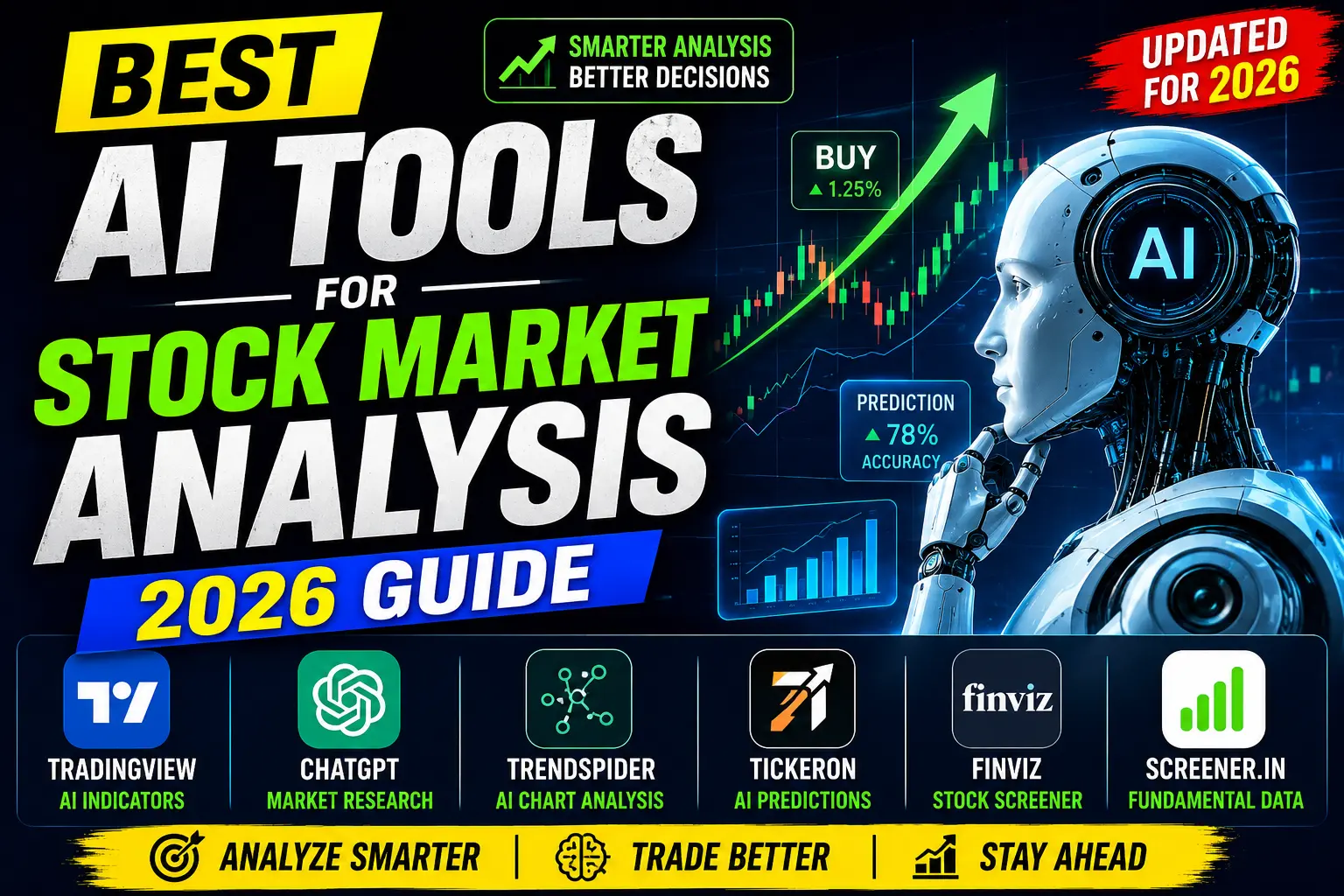
🧠 Introduction: The Battle That’s Changing the Stock Market
"AI vs human trading who wins in 2026?" — this isn't just a simple question anymore; it has become the biggest debate in the global financial world.
In the past, trading was a domain ruled exclusively by humans, relying on years of experience, intuition, and gut feelings. However, Artificial Intelligence (AI) has now completely disrupted the game.
Today’s advanced AI systems make split-second decisions, analyzing millions of data points simultaneously and executing trades with zero emotional bias. This shift raises a critical point for every investor: Is the era of human traders coming to an end? Or do humans still possess a hidden advantage that machines cannot replicate?
Let’s break this down step-by-step to find the definitive answer. By the end of this guide, you will have a clear picture of the future of stock market trading. 🔥
🤖 What is AI Trading? The Power of Algorithms
To put it simply, AI Trading is the synergy of high-speed machines, complex algorithms, and massive data analysis. It represents a shift from manual execution to a fully automated financial ecosystem.
In this setup, AI systems perform three core functions simultaneously:
- Historical Data Analysis: Scanning decades of market patterns in seconds.
- Real-Time Trend Tracking: Monitoring global news and price movements instantly.
- Automated Execution: Making buy or sell decisions without manual intervention.
This process is widely recognized as Algorithmic Trading or Automated Trading Systems. The primary goal is to remove human delay and emotional inconsistency from the equation.
⚡ Speed Comparison: The Instant Advantage
Imagine a sudden market crash or a "flash drop":
- Human Trader: Needs seconds to process the news, feel the pressure, and click 'Sell'.
- AI System: Detects the anomaly and executes the trade in milliseconds.
In 2026, those few seconds of delay can mean the difference between a profit and a massive loss.
📉 What is Human Trading? The Traditional Approach
Human Trading is the classical art of navigating the financial markets. It is a process where the individual stands at the center of every decision. Unlike machines, a human trader relies on a blend of technical analysis, fundamental research, and seasoned intuition.
In a typical trading session, a human trader:
- Analyzes Charts: Studies price action and patterns like Head & Shoulders or Candlesticks.
- Monitors Global News: Stays updated with geopolitical events and earnings reports.
- Crafts Strategy: Builds a unique plan based on personal risk appetite and market outlook.
- Manual Execution: Physically places the trade when the "perfect setup" arrives.
Success in manual trading isn't just about the math; it's about Experience, Psychology, and Discipline.
⚠️ The "Human" Factor: Fear & Greed
The biggest challenge? Humans are emotional beings. Even the best strategy can fail when Fear (selling too early) or Greed (holding too long) takes over. In 2026, where the market moves at lightning speed, a single second of hesitation due to emotional pressure can turn a winning trade into a significant loss.
While humans might be slower than algorithms, many argue that Human Intuition—the ability to read "between the lines" of a news report—is something a machine might never truly replicate.
⚔️ AI Trading vs Human Trading: Key Differences
In the fast-paced world of 2026, the gap between machine precision and human intuition is becoming clearer. Here is a direct comparison of the core factors that define modern trading:
| Factor | AI Trading (The Machine) | Human Trading (The Expert) |
|---|---|---|
| Speed | Ultra-fast (Milliseconds) ⚡ | Relatively Slow (Seconds/Minutes) |
| Emotion | Zero Bias / Logical only | High Impact (Fear & Greed) |
| Data Analysis | Analyses Massive Big Data | Limited Capacity |
| Accuracy | Extremely High & Consistent | Medium (Prone to human error) |
| Adaptability | Purely Pattern-based | Creative Thinking & Context |
The Verdict: While AI dominates in speed and precision, humans still lead when it comes to out-of-the-box thinking during unprecedented global events (like a sudden geopolitical crisis) where past data doesn't exist.
🚀 Why AI is Dominating the Markets in 2026
As we move through 2026, the data is clear: over 80% of global trading volume is now driven by algorithms. But what makes AI so powerful compared to a seasoned human trader? Let's look at the core advantages:
1. Speed That Humans Can’t Match ⚡
In the stock market, "Timing = Profit." While a human takes seconds or even minutes to process a price change and click 'Buy', an AI executes the same trade in microseconds. This speed advantage allows AI to capture tiny price gaps (Scalping) that are invisible to the human eye.
2. No Emotions, No Panic 🧠
Human traders often suffer from Revenge Trading after a loss or FOMO (Fear Of Missing Out) during a rally. AI has no ego, no fear, and no greed. It follows the pre-set strategy with 100% discipline, ensuring pure logic-based execution every single time.
3. Massive Data Processing (Big Data) 📊
An AI doesn't just look at one chart. Simultaneously, it analyzes:
- Real-time Social Media Sentiment (Twitter/X, Reddit).
- Global Economic Indicators & News wires.
- Millions of Historical Patterns in seconds.
For a human, processing this much information at once is simply impossible.
4. 24/7 Market Surveillance 🌙
Markets never truly sleep, especially with Crypto and Global Forex. While humans need rest, AI monitors the markets 24/7 without fatigue or distraction. It’s always ready to catch an opportunity, even if it happens at 3 AM.
⚠️ The Dark Side: Why AI Isn't Perfect (Yet)
As powerful as Artificial Intelligence is, it still has significant blind spots. In 2026, many traders have learned the hard way that blindly trusting an algorithm can lead to disaster. Here’s why:
1. Over-Dependence on Historical Data 📉
AI models are trained on the past. But what happens when a "Black Swan" event occurs? Whether it's a sudden geopolitical shift or an unprecedented economic policy, AI can become confused when there is no historical "map" to follow. If it hasn't happened before, the AI might not know how to react.
2. Lack of Real-World Understanding 🌎
AI can process millions of news headlines, but it often misses the deeper meaning or "subtext". It doesn't understand human sentiment, political nuances, or the "why" behind a market move. While AI sees numbers, humans see the global story.
3. The Trap of Over-Optimization (Curve Fitting) 🛠️
This is a common pitfall in 2026. Developers often build an AI strategy that looks "perfect" on paper using past data (Backtesting). However, the strategy is so tightly tuned to the past that it fails miserably in the unpredictable, live market. This is known as Over-Optimization.
"A machine can tell you what happened yesterday, but it takes a human mind to imagine what could happen tomorrow."
🧠 The Human Advantage: Why Traders Still Win in 2026
Despite the rise of supercomputers, human traders possess unique cognitive abilities that algorithms simply cannot replicate. In the volatile markets of 2026, these "human-only" traits are more valuable than ever.
1. Intuition & Decades of Experience 🌟
An experienced trader can "feel" the market sentiment. Beyond just numbers, they can detect unusual patterns or subtle shifts in trading volume that suggest a big move is coming. While AI looks for historical matches, a human uses gut feeling and seasoned intuition to stay one step ahead.
2. Unmatched Flexibility & Adaptation 🔄
Markets can change in a heartbeat. A human trader has the flexibility to pivot their entire strategy instantly when a new situation arises. Whether it's a sudden policy change or a global news break, humans can adapt to "New Normals" much faster than a machine stuck in its pre-programmed logic.
3. "Big Picture" Thinking 🌍
Humans excel at connecting the dots between geopolitical events, economic policies, and global social impacts. We don't just see a price drop; we understand the "Why" behind it—whether it's an election result, a trade war, or a technological breakthrough. AI sees data points; humans see the Global Narrative.
"Algorithms calculate, but humans comprehend."
🛑 The Bottleneck: Why Human Traders Struggle
While humans bring intuition to the table, we are also bound by biological and psychological limits. In the high-frequency environment of 2026, these weaknesses can be expensive.
1. The Emotional Rollercoaster (Fear & Greed) 😬
A human's biggest enemy isn't the market; it's their own mind. Fear makes you sell a winning trade too early, and Greed makes you hold a losing position for too long. This emotional bias is the #1 reason why 90% of retail traders lose money.
2. The Execution Gap (Speed) 🐢
The 2026 stock market moves at the speed of light. By the time a human trader sees a breakout, analyzes it, and manually enters the order, the "Big Move" might already be over. In a battle of Milliseconds vs. Seconds, the human is almost always at a disadvantage.
3. Cognitive Overload (Limited Data) 🧠❌
A human can realistically track maybe 5 to 10 stocks at once. But there are thousands of opportunities happening simultaneously across global markets. Unlike AI, humans suffer from Fatigue and Information Overload, meaning we often miss the best trades simply because we weren't looking at the right chart at the right time.
📊 AI Trading Performance vs Human Trading
Real-world data from 2026 suggests a fascinating split in performance styles. While both can be profitable, their paths to success are completely different:
- AI Systems: Deliver Consistent, High-Frequency Performance. They focus on small, compounding profits with a high win rate.
- Human Traders: Often see Erratic Performance—periods of massive "Home Run" profits followed by heavy drawdowns or losses.
🧪 Real-World Case Study: The 2026 Market Volatility
During the recent "Flash Crashes" of early 2026, the difference was clear:
❌ The Human Reaction: Panic selling due to fear, leading to locked-in losses.
✅ The AI Reaction: Executed a pre-calculated hedge within milliseconds, actually profiting from the downside.
This is why 95% of major Hedge Funds and Tier-1 Institutions have now fully integrated AI into their core desks.
🏆 Final Verdict: The Winner of 2026
So, after analyzing every factor, who stands at the top of the podium?
⚡ AI Wins In:
Speed, Accuracy, Consistency, and 24/7 Execution.
🧠 Human Wins In:
Creativity, Adaptability, and Crisis Management.
🥇 The 2026 Reality: The Hybrid Evolution
The winner isn't AI *or* Human. The winner is the **AI-Powered Human.**
In 2026, the most successful traders are those who use AI for data crunching and execution, while providing the Human oversight and strategy. This "Hybrid" or "Cyborg" approach is the ultimate edge in today’s stock market.