AI Text Watermark vs AI Detector vs C2PA: What Actually Proves AI Content?
“Was this written by AI?” sounds like one question, but in 2026 there are at least three very different ways to answer it: an embedded watermark, a probabilistic AI detector, or provenance metadata such as Content Credentials. Treating them as interchangeable is one of the biggest mistakes in AI-content verification.
Quick answer
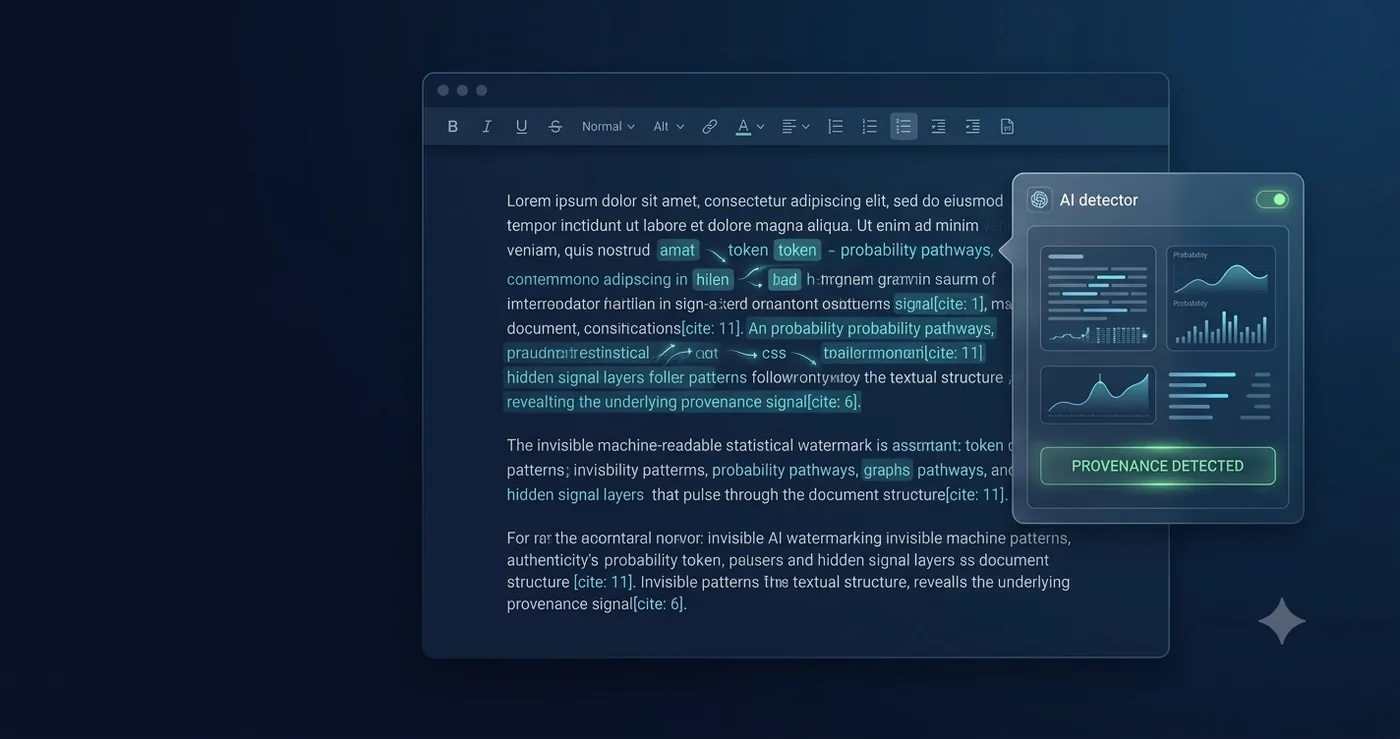
An AI text watermark is an intentional signal embedded during generation. An AI detector is a classifier that guesses whether text looks machine-generated. C2PA-style provenance records signed origin and edit information when supported. They solve related but different problems.
If you need high-confidence verification, the safest approach is not to ask one detector for a yes/no answer. Use a hierarchy of evidence: signed provenance or provider verification first, watermark detection where available, platform or generation records next, and generic AI-detector scores only as supporting evidence.
1. The three systems answer different questions
| Method | Main question | Best evidence | Main weakness |
|---|---|---|---|
| Text watermark | Does this text contain a signal intentionally embedded by a supported model? | Provider-controlled watermark detector | Can weaken after rewriting, translation or heavy editing |
| AI detector | Does this writing statistically resemble AI-generated text? | Probability/classification score | False positives and false negatives; no cryptographic proof |
| C2PA / Content Credentials | What tool created or edited this content, and is the signed provenance intact? | Signed metadata / provenance chain | Metadata can be stripped if the workflow does not preserve it |
2. What an AI text watermark actually is
Text watermarking changes the model’s generation choices so that a detector can later identify a statistical pattern. In many designs, the model subtly prefers certain tokens or token groups according to a secret rule. The visible meaning remains natural, but the sequence contains a signal.
OpenAI describes its current text watermarking approach as a machine-readable provenance signal embedded in wording, not hidden characters or invisible spaces. Anthropic has likewise stated that its approach is designed so readers cannot visually distinguish watermarked from unwatermarked text.
This matters because a watermark is fundamentally different from a detector. The detector for a watermark is looking for a pattern that was deliberately inserted. A generic AI detector is looking for stylistic or statistical clues that may occur naturally in human writing too.
For a broader explanation of how text watermarking works, see the existing Xenors guide: AI Text Watermarking 2026: Can AI Writing Be Detected?
3. Why paraphrasing is the stress test for watermarking
The central technical challenge is simple: text can preserve meaning while changing almost every surface token. A person can rewrite a paragraph, translate it, merge sentences, split sentences, or ask another model to paraphrase it. If the watermark lives mainly in token-level choices, the signal may degrade.
That is why 2026 research has moved beyond simple token-level watermarking. Work published at EMNLP 2026 proposes dual semantic embeddings to improve robustness under paraphrasing and translation. ICML 2026 papers such as AliMark and geometry-aware sentence-level methods similarly focus on preserving detectability under structural or semantic changes.
The research direction is encouraging, but the conclusion should remain conservative: robust does not mean indestructible. A watermark detector should report confidence, not pretend that every edited text has an unquestionable binary identity.
4. Why generic AI detectors are weaker evidence
Generic AI detectors do not need the original model to cooperate. They analyze features such as predictability, token distributions, sentence variation, burstiness or learned embeddings. This makes them convenient, but convenience is not the same as proof.
A detector can label original human writing as AI-like, especially when the writing is formal, repetitive, concise or non-native. It can also miss heavily edited AI text. The more a detector is treated as an accusation engine instead of a probabilistic screening tool, the more dangerous the workflow becomes.
5. What C2PA and Content Credentials add
C2PA is an open provenance standard that can attach signed information about where a file came from and what edits were made. OpenAI uses Content Credentials based on C2PA for supported media, and its provenance documentation describes these credentials as one layer in a broader transparency stack.
For files and media, provenance can be stronger than visual guessing because it is attached to a signed chain rather than inferred from style. The limitation is preservation: if a platform strips metadata, copies only plain text, takes a screenshot, or otherwise breaks the provenance chain, the credentials may no longer be available to the recipient.
For text specifically, C2PA does not magically solve every attribution problem. Plain text is copied, pasted, reformatted and rewritten constantly. That is why text watermarking and provenance systems are evolving together rather than one replacing the other.
6. What each method can and cannot prove
| Claim | Watermark | AI detector | C2PA/provenance |
|---|---|---|---|
| “This provider likely generated the text” | Potentially strong if provider-specific watermark verifies | Weak | Strong only when signed origin is preserved and applicable |
| “A human definitely did not write this” | No | No | No |
| “The content has not been edited” | No | No | Potentially, if edit history is signed and intact |
| “The text was paraphrased after generation” | May become harder to verify | May change score unpredictably | Only if workflow records the transformation |
| “This proves misconduct” | No | No | No; provenance is origin evidence, not intent evidence |
7. A stronger verification workflow for schools, publishers and businesses
- Check for signed provenance first. If Content Credentials or provider verification exists, validate it using the official verifier.
- Check provider watermark evidence. Use the provider’s detector when the model and watermark scheme are supported.
- Review generation records. Platform logs, document history, revision history and source drafts often provide stronger contextual evidence than a generic detector.
- Use generic AI detectors only as a supporting signal. Never treat one percentage score as proof.
- Compare writing process evidence. Draft evolution, citations, notes and revision history may matter more than stylistic classification.
- Escalate high-stakes cases to human review. The consequence of a false positive is often much larger than the cost of a second review.
8. Watermarking and the EU AI transparency push
In October 2026, OpenAI published additional detail on its approach to EU text-provenance requirements and described text watermarking as part of compliance with the EU AI Act. OpenAI’s Help Center also documents textGrain and explains that watermarking changes token choices rather than adding visible markers.
Anthropic separately announced a text-watermarking approach for future Claude outputs, also connecting the move to EU transparency requirements. The significance is broader than any single company: watermarking is becoming an infrastructure layer for AI provenance, not just an academic experiment.
9. Why watermarking does not make AI detectors obsolete
Watermarking only works when the generating model participates. Open-source models, local models, older outputs, transformed content or unsupported tools may not carry a compatible watermark. Generic detectors can still be useful as triage tools in those situations.
But the correct mental model is:
- Watermark = embedded evidence.
- Provenance = signed origin/history evidence.
- AI detector = statistical suspicion.
That ordering helps prevent the common mistake of giving a generic detector more authority than a provider-controlled provenance signal.
10. What SEO teams and publishers should do
For publishers, the practical issue is not “Will Google punish every AI-written sentence?” The stronger question is whether the content is original, useful, accurate, attributable and created with a responsible editorial process.
Watermarking may eventually make provenance easier to verify, but it does not replace editorial quality. A low-value article remains low-value whether it has a watermark or not. Likewise, a carefully researched article can contain AI-assisted drafting while still requiring human fact-checking, source review, editing and accountability.
Xenors’ own strategy should therefore focus on information gain, primary technical sources, real implementation detail and clear editorial ownership, not on trying to “beat” AI detectors.
11. What changes after paraphrasing or translation
Paraphrasing is where the distinction between methods becomes obvious. A generic detector may move from 90% “AI” to 20% after a rewrite without any change in underlying authorship. A token watermark may weaken because its preferred token pattern has been replaced. A semantic watermark may survive better, but research still treats robustness as an active problem.
Translation is similarly difficult because the token sequence changes completely. The 2026 dual-semantic-embedding work is notable precisely because it targets paraphrasing and translation resilience. That is evidence of progress, but also evidence that these transformations remain central attack surfaces.
12. Can watermarking be removed intentionally?
Some transformations can reduce detectability: aggressive paraphrasing, translation, sentence restructuring, mixing with human-written text or generation through another model. There is no universal “remove watermark” button because watermark designs differ, and newer methods are specifically designed to survive edits.
The relevant takeaway for verification teams is not how to defeat a watermark; it is that absence of a detectable watermark is not proof of human authorship. The content may come from an unwatermarked model, an unsupported system, or a transformation that weakened the signal.
13. Best evidence hierarchy in 2026
| Rank | Evidence type | Typical confidence |
|---|---|---|
| 1 | Signed, verified provenance / provider records | Highest when intact |
| 2 | Provider-specific watermark verification | Strong within supported conditions |
| 3 | Platform logs, document history, drafts and audit records | Strong contextual evidence |
| 4 | Multiple independent statistical detectors | Supporting evidence only |
| 5 | Visual/style intuition (“this sounds like AI”) | Weakest |
14. Frequently asked questions
Is an AI text watermark the same as an AI detector?
No. A watermark is deliberately embedded during generation. A generic detector infers whether writing resembles machine-generated text.
Can paraphrasing remove an AI watermark?
It can weaken some schemes. Newer semantic watermarking research aims to survive paraphrasing and translation more reliably, but no scheme should be assumed unbreakable.
Does C2PA prove AI authorship?
C2PA proves signed provenance information when the credentials and chain are intact. It is not a universal classifier of plain text.
Can an AI detector prove cheating?
No. Detector output should be treated as probabilistic evidence, not definitive proof of misconduct.
What is the best method?
Use multiple layers: signed provenance, provider watermark verification, generation records and human review. Generic detectors should sit lower in the evidence hierarchy.
15. Related Xenors guides
- AI Text Watermarking 2026: Can AI Writing Be Detected?
- AI Agent Guardrails & Safety
- AI Agents and Office Data Security Risks
- Google Gemini Agent for Work
Primary sources and research
- OpenAI — Advancing content provenance for a safer, more transparent AI ecosystem
- OpenAI — Our approach to EU text provenance rules
- OpenAI Help Center — Provenance signals in OpenAI-generated content
- Anthropic — How Claude's text watermark works
- EMNLP 2026 — Robust Text Watermarking via Dual Semantic Embeddings
- ICML 2026 — AliMark: Robust Sentence-Level Watermarking Against Paraphrasing
- ICML 2026 — Geometry-aware Sentence-level Watermarking