🧠 What is AI Trading in 2026?
In the rapidly shifting financial landscape of today, AI trading in 2026 has evolved from a futuristic concept into the functional backbone of modern investing. At its core, AI trading refers to the strategic use of Artificial Intelligence and Deep Learning to analyze massive datasets, forecast market trends, and execute trades with surgical precision—all without human emotional bias.
"Unlike traditional manual trading, where a human might track 2 or 3 charts simultaneously, modern AI systems in 2026 process millions of global data points—from interest rate hikes to viral social media sentiment—in less than a millisecond."
The democratized access to high-performance computing means that AI trading for beginners 2026 is now more accessible than ever. You no longer need a wall of monitors or a Ph.D. in Mathematics to leverage algorithmic power; you just need the right framework.
How AI Trading Systems Actually Work
Today’s sophisticated trading bots rely on a multi-layered technological stack to outperform the general market:
- ✔️ Machine Learning Algorithms: These models "learn" from decades of historical market cycles, identifying complex patterns that are invisible to the naked human eye.
- ✔️ Sentiment Analysis (NLP): In 2026, AI scans global news, earnings calls, and Twitter (X) trends using Natural Language Processing to predict a stock's movement before the news even hits the mainstream media.
- ✔️ High-Frequency Execution: Speed is the ultimate currency. AI systems execute orders at lightning velocity, capturing "alpha" or profit margins from tiny price fluctuations (arbitrage) that humans simply can’t catch.
- ✔️ Adaptive Risk Management: These systems don't just chase profits; they act as a digital shield. They use dynamic stop-loss triggers and real-time position sizing based on current market volatility.
Ultimately, AI trading in 2026 isn't about replacing the investor—it's about empowering them with an emotionless, data-driven superpower to navigate the volatile waves of the stock and crypto markets.
📈 Why AI Trading is Growing Fast in 2026?
The shift from manual trading to algorithmic automation isn't just a trend—it’s a fundamental evolution of the financial ecosystem. In 2026, AI trading growth is driven by the need for speed, precision, and a level of consistency that the human brain simply isn't wired to maintain.
⚡ Unmatched Speed & Execution
In 2026, market volatility can wipe out profits in seconds. AI systems eliminate the "latency" of human reaction. They can identify a breakout and execute a trade across multiple exchanges simultaneously, ensuring you get the best possible entry price before the retail crowd even sees the candle move.
📊 Data-Driven Logic vs. Fear & Greed
The biggest enemy of a trader is their own mind. Fear of missing out (FOMO) and revenge trading are the primary causes of portfolio liquidations. AI trading tools operate on cold, hard data. They stick to the predefined strategy regardless of market panic, ensuring a disciplined, long-term success rate.
💰 True Passive Income Potential
The "Always-On" nature of global markets (Forex, Crypto, and International Equities) makes it impossible for humans to monitor 24/7. AI allows you to capture opportunities in the US or European markets while you sleep in India. It’s the ultimate tool for achieving financial freedom through automation.
🌍 Democratized Institutional Power
Previously, high-end algorithms were only available to Wall Street banks. Today, the rise of AI stock trading for beginners means retail investors can compete on an even playing field. With cloud-based bots and easy API integrations (like 5Paisa or Zerodha), the "edge" is now in everyone's hands.
Because of these compounding advantages, we are seeing a record-breaking surge in search volume for how to start AI trading step by step. The market is no longer asking if AI works, but rather which AI works best.
Pro Insight: In 2026, over 85% of the total trading volume on major stock exchanges is estimated to be generated by algorithmic and AI-driven systems.
🔰 AI Trading for Beginners 2026: Myths vs. Reality
If the term "AI Trading" brings up images of complex green code raining down like The Matrix, let’s clear the air right now. In 2026, you don't need to be a Silicon Valley engineer to start your journey. The gap between professional hedge fund managers and retail beginners has never been smaller.
🚀 The Beginner's Reality Check
Before you dive into the "How-to," understand these three core pillars of AI trading for beginners 2026:
🎯 Your Core Strategy for 2026
The most successful beginners don't look for "Get Rich Quick" bots. Instead, AI trading in 2026 for new investors is focused on three sustainable areas:
| Focus Area | What to do? |
|---|---|
| Tool Selection | Pick platforms with built-in backtesting and "copy-bot" features. |
| Strategy Logic | Focus on "Trend Following" or "Mean Reversion"—the two most reliable AI logics. |
| Risk Shield | Set hard stop-loss limits that even the AI cannot override. |
Remember, the goal for any beginner in the first 90 days is Capital Preservation. Once you understand how your AI reacts to market volatility, scaling up becomes a data-driven decision rather than a gamble.
🚀 How to Start AI Trading Step by Step (The 2026 Roadmap)
Starting your AI trading journey doesn't have to be overwhelming. If you follow this structured 6-step framework, you can move from a complete beginner to a data-driven trader in just a few weeks. Here is the definitive guide on how to start AI trading step by step.
✅ Step 1: Master the Market Fundamentals
Before you let an AI take control, you must understand the rules of the game. You don't need to be a pro, but you must grasp:
- Price Action: How stocks move (Support, Resistance, and Trends).
- Market Cycles: Understanding Bull vs. Bear phases.
- Risk Management: Learning why you should never risk more than 1-2% of your capital on a single trade.
✅ Step 2: Choose a Reliable Brokerage Platform
In 2026, your broker must support API Integration. Without a fast API, your AI bot cannot execute trades.
Best Choices in India: Zerodha (Kite Connect), Upstox, or 5Paisa.
Best International Choices: Interactive Brokers or TD Ameritrade.
✅ Step 3: Select Your AI Trading Tool
Don't build from scratch if you're a beginner. Choose No-Code AI Trading Tools that offer pre-built strategies. Look for features like "Backtesting" (testing on old data) and "Cloud Deployment" (so your bot runs 24/7 without your laptop being on).
✅ Step 4: Run a "Paper Trading" Diagnostic
Never go live on day one. Use a Demo Account to let your AI trade with virtual money. This allows you to see how the algorithm behaves during high-impact news events or sudden market crashes without any financial risk.
✅ Step 5: Start with Micro-Capital
Once you are confident, start with "Skin in the game" but keep the capital small. The transition from paper money to real money often reveals technical "slippages." Scaling gradually is the secret to long-term AI trading success.
✅ Step 6: Monitor, Audit, and Optimize
Automation does NOT mean "Set and Forget." In 2026, the best traders audit their bots weekly. Track your:
- Win Rate: Percentage of profitable trades.
- Drawdown: The maximum dip your account took.
- Strategy Drift: Is the market changing faster than your AI?
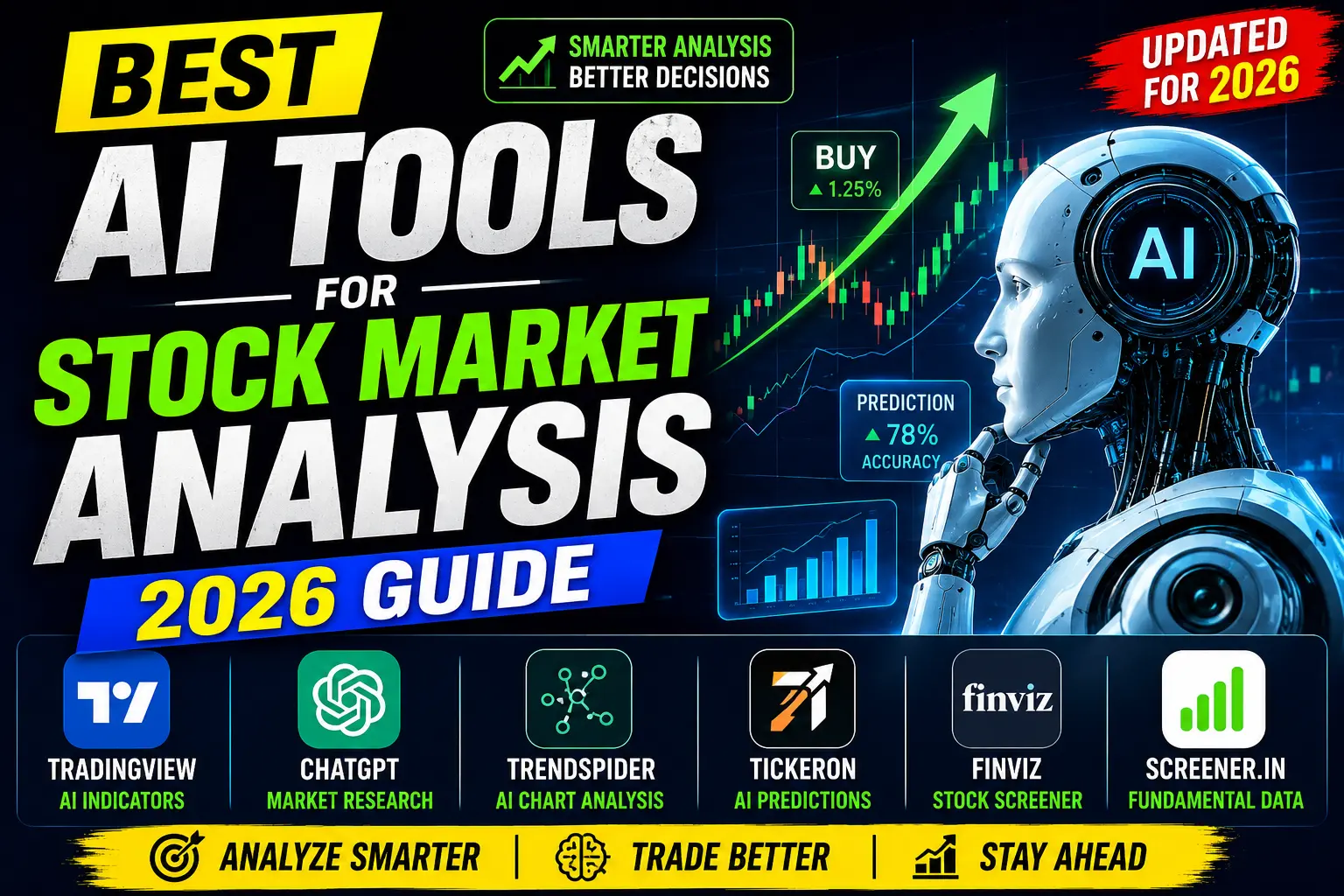
🔥 Best AI Trading Tools 2026: Expert Reviews
In 2026, the gap between a winning and losing strategy often comes down to the software you use. These best AI trading tools 2026 are recognized for their reliability, advanced neural network integration, and high-speed execution capabilities.
1. Trade Ideas (The Holly AI)
Trade Ideas remains the industry leader for real-time market scanning. Its proprietary AI, "Holly," runs over 70 different algorithms every night to identify the highest probability setups for the next trading session.
- Automated Execution: Connect directly to brokers for hands-free trading.
- Brokerage Plus: Build and backtest complex strategies without writing a single line of code.
2. TrendSpider (AI-Powered Charting)
TrendSpider revolutionizes the way traders view charts. By using Machine Learning, it automates the manual grunt work of drawing trendlines, identifying Fibonacci levels, and detecting candlestick patterns.
- Strategy Tester: Instantly see how your strategy performed in the past.
- Multi-Timeframe Analysis: View patterns across different time layers on a single chart.
3. Tickeron (Pattern Recognition Engine)
Tickeron is a powerhouse for Pattern Recognition. It scans the entire stock market to find Double Bottoms, Head & Shoulders, and other high-value patterns, providing a "Confidence Level" for every prediction.
- AI Trend Forecast: Predictive analysis for short and long-term price movements.
- Robo-Advisors: Ready-to-use AI portfolios tailored to your risk appetite.
🛠️ Advanced Tools for Developers
If you are comfortable with Python, C#, or MQL5, these institutional-grade platforms are the gold standard for building custom algorithmic trading bots.
🇮🇳 AI Stock Trading for Beginners India (2026 Edition)
India has emerged as one of the fastest-growing hubs for algorithmic finance. With the combination of affordable high-speed internet and a massive surge in Gen-Z retail investors, the landscape for AI stock trading for beginners India is more fertile than ever.
Top Platforms for Indian Traders
In 2026, these fintech giants offer the most stable API bridges for AI integration:
- Zerodha (Kite Connect): The gold standard for developers and retail algo-traders.
- Angel One & Groww: Offering increasingly simplified "SmartAPI" access for beginner-friendly bots.
- Upstox: Known for high-speed execution and reliable data feeds.
🌍 Global AI Trading: Insights for Tier-1 & Emerging Markets
If you are looking to diversify your portfolio beyond Indian shores, AI trading in 2026 offers unique opportunities across different regulations and time zones.
🇺🇸 USA & 🇨🇦 Canada
The most advanced market for AI. High competition but massive volume.
- Top Tools: Trade Ideas, Tickeron, Alpaca Markets.
- Strategy: Focus on Sentiment Analysis from Wall Street news and Fed announcements.
- Tip: Leverage 24/7 crypto-to-stock correlations.
🇬🇧 UK & 🇪🇺 Europe
Heavily regulated by FCA/ESMA, ensuring high security for AI traders.
- Top Tools: eToro (Copy Trading AI), MetaTrader 5.
- Strategy: Forex-heavy AI models perform exceptionally well here.
- Tip: Ensure your AI bot is MiFID II compliant to avoid account flags.
🇦🇺 Australia (ASX)
A great market for lower volatility and steady AI-driven dividend harvesting.
- Top Tools: CommSec, Selfwealth (with API).
- Strategy: Mean-reversion strategies on mining and banking stocks.
🇷🇺 Russia & 🇨🇳 China
Fragmented but high-reward markets for aggressive AI models.
- Challenge: Political volatility and "The Great Firewall" can impact latency.
- Strategy: Use AI to track Government Policy shifts rather than just technical charts.
💡 Critical Tips for International Beginners:
- Respect SEBI/FCA/SEC: Never use "unverified" black-box bots that promise 100% returns; they are usually scams.
- Latency Matters: If trading US stocks from India, use a VPS (Virtual Private Server) located in New York or London to reduce execution delay.
- Tax Implications: Be aware of LRS (Liberalised Remittance Scheme) in India for foreign stock investments and local capital gains taxes.
🤖 Can AI Trade Stocks Automatically? (The Truth in 2026)
The short answer is Yes. In 2026, fully autonomous trading is not only possible but accounts for the majority of the volume on the NYSE and NASDAQ. However, "automatic" doesn't mean "magic." It is a systematic process where software executes logic-based decisions.
How the Automation Loop Works
Every automated system, from simple bots to advanced neural networks, follows this 4-stage execution cycle:
(News, Prices, Social Media)
(AI identifies "Buy" pattern)
(Bot sends order to Broker)
(Trailing stop-loss update)
Levels of Automation in 2026
Depending on your comfort level and technical skill, you can choose how much "control" you give to the machine:
| Type | How it Works | Best For |
|---|---|---|
| Fully Automated | The bot enters and exits trades 24/7 without asking you. | Passive investors & Scalpers. |
| Semi-Automated | The AI finds the setup, but you click the "Approve" button. | Intermediate traders who want control. |
| Signal-Based | AI sends a Telegram/Email alert; you execute manually. | Beginners learning price action. |
⚠️ The "Human-in-the-Loop" Rule
Even the most advanced AI in 2026 can fail during "Black Swan" events (unpredictable global crises). Professional traders always maintain "Human Supervision" to shut down bots if market conditions deviate too far from the backtested data.
So, if you are asking "Can AI trade stocks automatically?", the answer is a resounding yes—but successful traders treat their bots like employees, not genies. You must manage them, audit their performance, and update their "intelligence" as market regimes shift.
⚖️ The Double-Edged Sword: Benefits and Risks of AI Trading
In 2026, the debate is no longer about whether AI trading works, but how to manage its immense power. While the advantages can give you a massive edge, the risks can be catastrophic if not managed with professional discipline.
✅ Key Benefits
- Millisecond Execution: AI reacts to price movements in 1/1000th of a second, capturing "Slippage-free" entries that humans simply cannot see.
- Psychological Immunity: 90% of retail traders fail due to fear and greed. AI follows the backtested strategy without hesitation, even during extreme market panic.
- Infinite Scalability: A human can track 5 stocks; an AI can track 5,000 across Global Markets simultaneously, 24 hours a day.
- Data-Driven Accuracy: By processing "Alternative Data" (satellite imagery, shipping logs, and social sentiment), AI identifies Alpha opportunities before they hit the news.
⚠️ Significant Risks
- The "Over-Optimization" Trap: Known as Curve Fitting, where a bot performs perfectly on past data but fails miserably in real-market conditions.
- Technical System Failure: API disconnects, VPS downtime, or "Flash Crashes" caused by algorithmic feedback loops can lead to rapid capital loss.
- Market Unpredictability: No AI can predict "Black Swan" events like sudden geopolitical shifts or regulatory crackdowns.
- Model Drift: As the market evolves, an AI model that worked in 2025 might become obsolete in 2026 without constant re-training.
🛡️ How to Stay Safe in 2026
The secret to longevity in AI trading in 2026 is the "Kill Switch." Always have a manual override ready and never allocate more than 20% of your total portfolio to a single automated strategy. Diversity is your only true hedge against algorithmic error.
⚠️ Critical Mistakes Beginners Make in AI Trading
The technology behind AI trading in 2026 is more powerful than ever, but it is not a "magic lamp." Most beginners lose their capital not because the AI failed, but because they lacked a disciplined framework. Avoid these four common traps to stay in the game long-term.
❌ Over-Capitalizing Early
The biggest error is "going all-in" on day one. Beginners often see a backtested profit and assume it will repeat. In reality, live market "slippage" and execution delays can change results. The Rule: Start with only 10% of your intended capital until the bot proves itself for 30 days.
❌ The "Set and Forget" Fallacy
Blindly trusting AI tools is a recipe for disaster. Markets are dynamic; an algorithm designed for a "Trending Market" will fail in a "Sideways Market." You must audit your bot's logic weekly to ensure it still aligns with current market regimes.
❌ Neglecting Risk Parameters
Beginners often turn off "Stop-Loss" features, thinking the AI is "too smart" to lose. In 2026, flash crashes can happen in seconds. Without hard-coded risk management (like max daily loss limits), a single software glitch can wipe out months of profit.
❌ Zero Foundational Knowledge
Using AI without knowing what a "Moving Average" or "RSI" is, is like flying a plane on autopilot without knowing how to land. If the AI stops working, you won't know why. You must learn the fundamentals of price action to effectively supervise your automation.
"Successful AI trading is 20% choosing the bot and 80% managing the risk. Automation is a tool for leverage, not a substitute for intelligence."
🏆 The Master Strategy: How to Succeed in AI Trading (2026)
Success in the world of automated finance isn't about finding a "holy grail" bot; it’s about building a robust system. As we navigate AI trading in 2026, the winners will be those who treat technology as a partner, not a replacement. Here is your 5-pillar success checklist.
Start Small & Scale via Data
Never deploy 100% of your capital on a new algorithm. Use the "10/90 Rule": Start with 10% of your budget, and only increase your position size after the bot maintains a consistent Sharpe Ratio for at least 4 weeks of live trading.
Leverage Industry-Validated Tools
Stick to platforms with transparent backtesting data like TrendSpider or Trade Ideas. Avoid "Black Box" bots from unverified Telegram groups that don't allow you to audit the underlying logic.
Commit to Continuous Learning
AI models require periodic re-tuning. Markets shift from "Trending" to "Range-bound" cycles. To succeed, you must stay updated on macro-economic trends and how they impact your bot’s specific logic.
Prioritize Adaptive Risk Management
Use dynamic stop-losses and Position Sizing based on current market volatility (ATR). Your goal in 2026 is not to win every trade, but to ensure that your "drawdowns" are small enough to keep you in the game.
The Hybrid Approach (AI + Human)
The most profitable traders use Centaur Trading—using AI for heavy data lifting and pattern recognition, while the human makes the final high-level decision during major global events.
Ready to Start Your AI Trading Journey?
The future of the stock market is algorithmic. By starting today with a disciplined, step-by-step approach, you are positioning yourself ahead of 90% of retail investors.
Analyze. Automate. Achieve.
🏁 Final Thoughts: Your Future with AI Trading in 2026
The financial markets of 2026 are faster, smarter, and more data-driven than ever before. As we have explored in this guide, AI trading is no longer a luxury reserved for institutional hedge funds—it is a fundamental tool for any retail investor looking to gain a competitive edge.
Whether you are just starting with AI trading for beginners 2026 or looking to automate a complex manual strategy, the path to success remains the same: Education, Small-Scale Testing, and Disciplined Risk Management.
🚀 Key Takeaways for Your Journey:
- Efficiency: Let the AI handle the data-crunching while you focus on high-level strategy.
- Consistency: Automation removes the emotional "noise" that leads to trading errors.
- Scalability: Expand your reach across Global Markets (India, USA, UK) without losing sleep.
❓ Frequently Asked Questions
Is AI trading legal in India and the USA?
Yes, algorithmic and AI trading are completely legal. In India, SEBI provides guidelines for API-based trading, while in the USA, the SEC and FINRA regulate the use of automated systems to ensure market fairness.
How much money do I need to start AI trading?
You can start with as little as $100 or ₹10,000 using micro-lots. The key is not the amount of capital, but the consistency of the algorithm. Most experts recommend starting with a Paper Trading account first.
Can AI trading replace a full-time job?
While AI trading can generate significant passive income, it should be treated as a business. It requires constant monitoring and optimization. Many successful traders use it to supplement their income before transitioning full-time.
© 2026 AI Trading Master Guide | All Rights Reserved.
Disclaimer: Trading stocks involves risk. Past performance of AI bots does not guarantee future results.
🔗 Essential Resources & Quick Links
Explore more in-depth guides and tools to master the 2026 financial markets.
Final Strategy to Succeed in AI Trading
Risk management remains king. Even with AI, a solid backtesting strategy is your best defense.
❓ Frequently Asked Questions (FAQ)
Everything you need to know about starting your AI trading journey in 2026.