
5 Simple Steps to Start Budgeting for Beginners in 2026

The cryptocurrency market changes fast, but one sector has continued attracting serious attention from investors, developers, and institutions: AI crypto projects.
Artificial intelligence is no longer just a trend in tech. In 2026, advanced AI tools are being deeply integrated into algorithmic trading, portfolio automation, cybersecurity, decentralized infrastructure (DePIN), and even blockchain governance. As AI adoption grows globally, many crypto projects connected to AI are gaining massive momentum.
But here is the important truth most influencers do not mention: Not every AI crypto coin is revolutionary. Many projects use the word “AI” only for marketing leverage.
Some protocols have weak products, low user adoption, or unsustainable inflationary token models. That is why smart investors are now focusing less on social media hype and more on real utility, developer activity, ecosystem growth, strategic partnerships, and long-term relevance before the next crypto bull run kicks in. In this guide, we will explore some of the most talked-about AI crypto coins and explain what actually makes them interesting.
The rise of generative AI platforms, machine learning tools, and autonomous systems has fundamentally changed how global businesses operate. Companies worldwide are integrating AI into customer service, finance, healthcare, security, logistics, and real-time data analysis.
Blockchain projects are now leveraging this momentum to combine decentralized technology with advanced AI capabilities. This powerful combination is attractive because:
This convergence has created an entirely new asset class known as AI crypto. However, investors should understand that this sector is still highly experimental. While some infrastructure projects could become major foundational layers in the future, others may disappear completely once the hype cycles settle. That is why data-driven research matters more than speculation.
Before investing or analyzing specific altcoins, it is crucial to understand the foundational metrics that separate high-utility AI Web3 infrastructure from speculative meme tokens. Smart money looks at fundamentals, not just trending hashtags.
Does the project actually integrate machine learning or data science in a meaningful way? Many low-cap tokens add "AI" to their whitepapers purely as a marketing gimmick without deploying actual machine learning models. Strong, long-term projects usually provide tangible solutions such as:
A thriving, open-source developer ecosystem is one of the most reliable leading indicators of a project's survival. Projects with consistent GitHub commits, frequent mainnet upgrades, active developer documentation, and hackathon participation generally build sustainable products that outlast temporary market cycles.
Institutional credibility matters more than retail influencer hype. Strong AI crypto protocols actively secure strategic partnerships with major cloud providers, tech enterprises, academic AI labs, or established layer-1 blockchain ecosystems. True network adoption, data consumption volume, and active validator node counts are the ultimate metrics of success.
A sustainable crypto asset must possess genuine internal utility within its native decentralized network. Avoid projects where the token serves no purpose other than speculation. High-value networks integrate their native token for:
Will the technology still matter in 5 years? This is the ultimate question institutional macro investors ask. The AI space evolves rapidly, and a project that is cutting-edge today might become obsolete tomorrow. True relevance belongs to platforms building foundational layers that cannot be easily replicated by centralized competitors.
While looking for high-multiplier altcoins, smart investors structure their crypto asset allocation starting with market leaders, as they dictate the macro liquidity flows across the entire Web3 ecosystem.
Although Bitcoin is not technically an AI-native coin, it remains the absolute foundation of the entire digital asset landscape. Historically, every major crypto bull run begins with a spike in Bitcoin dominance. When capital flows aggressively into BTC, it acts as a catalyst for the broader altcoin markets.
Why Bitcoin Still Dictates the Macro Trend:
Risk Reality Check: Despite institutional adoption, BTC remains highly volatile. Major market flash crashes can cause sharp downside corrections, directly impacting high-beta AI altcoins.
Ethereum powers the vast majority of the decentralized ecosystem. A significant percentage of advanced AI crypto applications, autonomous data indexes, and decentralized finance (DeFi) networks choose to deploy on Ethereum because of its robust smart contract infrastructure and unmatched developer network.
Why Ethereum Remains Crucial for AI Integration:
Hosts the largest pool of decentralized liquidity, developer tooling, and secure smart contracts.
Networks like Base, Arbitrum, and Optimism allow AI protocols to process heavy data transactions at fractional costs.
The Operational Truth: While Ethereum faces continuous competition from faster Layer-1 blockchains, its massive infrastructure depth and security model ensure its long-term structural relevance.
Render is officially one of the powerhouse infrastructure pillars of the DePIN (Decentralized Physical Infrastructure Networks) sector. Originally deployed on Ethereum as RNDR, the protocol successfully completed its core migration to the Solana blockchain, rebranding the native utility asset to RENDER to ensure high-speed, cost-effective scaling.
AI models, deep learning networks, and next-gen 3D visual effects require massive graphical processing power. Render creates a decentralized, peer-to-peer marketplace where node operators can monetize their idle GPU hardware by computing complex workloads for AI developers and digital creators.
The Risks: While Render has massive narrative tailwinds and high processing volumes, it operates in a highly aggressive infrastructure market, directly competing with centralized cloud behemoths like AWS and Google Cloud.
In a historic industry consolidation, **Fetch.ai (FET) and SingularityNET (AGIX)** officially merged their ecosystems to form the Artificial Superintelligence Alliance (ASI). This foundational merger was executed to challenge big tech's centralized control over artificial general intelligence.
Instead of managing separate tokens, the ecosystem now coordinates under a unified model:
The Outlook: Combining these protocols removes ecosystem fragmentation, but long-term structural valuation depends entirely on actual enterprise integration and developers choosing decentralized nodes over traditional SaaS networks.
Bittensor is structurally unique because it functions as an open-source, decentralized protocol powering a global marketplace for machine learning algorithms. Under its incentive-based architecture, subnet token distribution rewards miners who supply the highest-quality computational answers or pre-trained models.
Analysts watch TAO closely because it incentivizes collaborative, crowdsourced artificial intelligence. However, Bittensor remains an highly complex, experimental architecture whose utility relies heavily on whether raw decentralized compute outputs can maintain competitive accuracy metrics against trillion-parameter private models.
Solana is not an AI-exclusive altcoin, but it has fundamentally become the primary network choice for deploying consumer-facing AI dApps, autonomous agent networks, and high-frequency DePIN layers. Thanks to its parallel processing capabilities and near-zero transaction costs, developers can deploy complex smart contracts without worrying about network congestion or high gas fees.
Investors track SOL because its explosive liquidity and active ecosystem capture massive beta flows whenever the AI and data analytics sectors experience speculative momentum.
The single most destructive pitfall for beginner traders is purchasing low-cap altcoins purely because they are trending on social media. Viral, short-term algorithmic hype cycles can easily manufacture temporary price pumps, but long-term survivability requires structural depth.
Sustainable asset appreciation before a true crypto bull run is driven by: Real Technical Utility • Active GitHub Commits • Ecosystem Data Consumption • Institutional Demand • Fair Tokenomics Models
An asset trending on Twitter or TikTok does not imply structural stability. Many high-risk, low-utility projects pay for influencer promotion to generate retail exit liquidity. Always prioritize objective network metrics, on-chain volume tracking, and independent fundamental analysis over social media hype.
While AI crypto projects offer astronomical growth potential, they simultaneously carry an incredibly steep risk profile. High-beta tech narratives are double-edged swords. Before deploying your hard-earned capital, internalize these foundational market realities:
The Golden Rule of Web3 Risk Management: No financial return in digital assets is guaranteed. Avoid emotional FOMO decisions and never allocate capital that you cannot afford to lose completely.
The structural expansion of the decentralized machine learning sector will likely be catalyzed by several convergence factors across both tech and finance:
As enterprise companies ramp up machine learning budgets, the demand for secondary, open-source infrastructure like DePIN will surge.
Traditional venture capital firms are pivoting from pure software plays toward tokenized cloud infrastructure treasuries.
Protocols providing immediate on-chain computation or functional web-scraping agents will attract sustainable capital over hype.
Instead of chasing parabolic green candles on short-term charts, baseline your trading approach around structural discipline:
The intersection of artificial intelligence and decentralized ledger technology is arguably the most transformative frontier in modern Web3 architecture. Core legacy networks like Render Network (RENDER) and newly consolidated powerhouses like the Artificial Superintelligence Alliance (ASI) prove that open-source, trustless networks can challenge big tech's centralized monopolies.
However, long-term market survival demands strict objectivity. Separate the marketing whitepapers from deployed technical architectures. Cultivate patience, prioritize technical utility, and protect your capital by placing informed, data-driven decisions far above social media speculation.
Infrastructure-heavy protocols offering tangible resources—such as Render Network for distributed GPU cloud rendering, and the Artificial Superintelligence Alliance (ASI) for deployable autonomous agent nodes—demonstrate the highest real-world utility.
Not necessarily. While AI altcoins inherently present higher asymmetric upside during an explosive narrative cycle, they carry significantly higher volatility and structural smart contract risks compared to foundational assets like Bitcoin or Ethereum.
While macro growth suggests it is highly possible for top-tier utility tokens, historical trends prove that performance relies completely on organic developer retention, product delivery, and overall systemic liquidity cycles.
Yes. The global reliance on machine learning, dataset validation, and computing resources is growing exponentially. However, while the macro narrative is structural, individual tokens will constantly fluctuate based on protocol-level execution.
Absolutely not. Beginners should treat high-beta AI altcoins as speculative assets. The smartest path is allocation mapping—starting with a dominant foundation of BTC/ETH and only allocating a fractional percentage to early-stage AI nodes after performing deep fundamental analysis.
5 Simple Steps to Start Budgeting for Beginners in 2026

Stock Market Today: SpaceX IPO, Bitcoin & Wall Street Trends
Top AI Stocks in Dow Jones to Watch in 2026

Can ChatGPT Predict Crypto Prices? Real AI Test in 2026
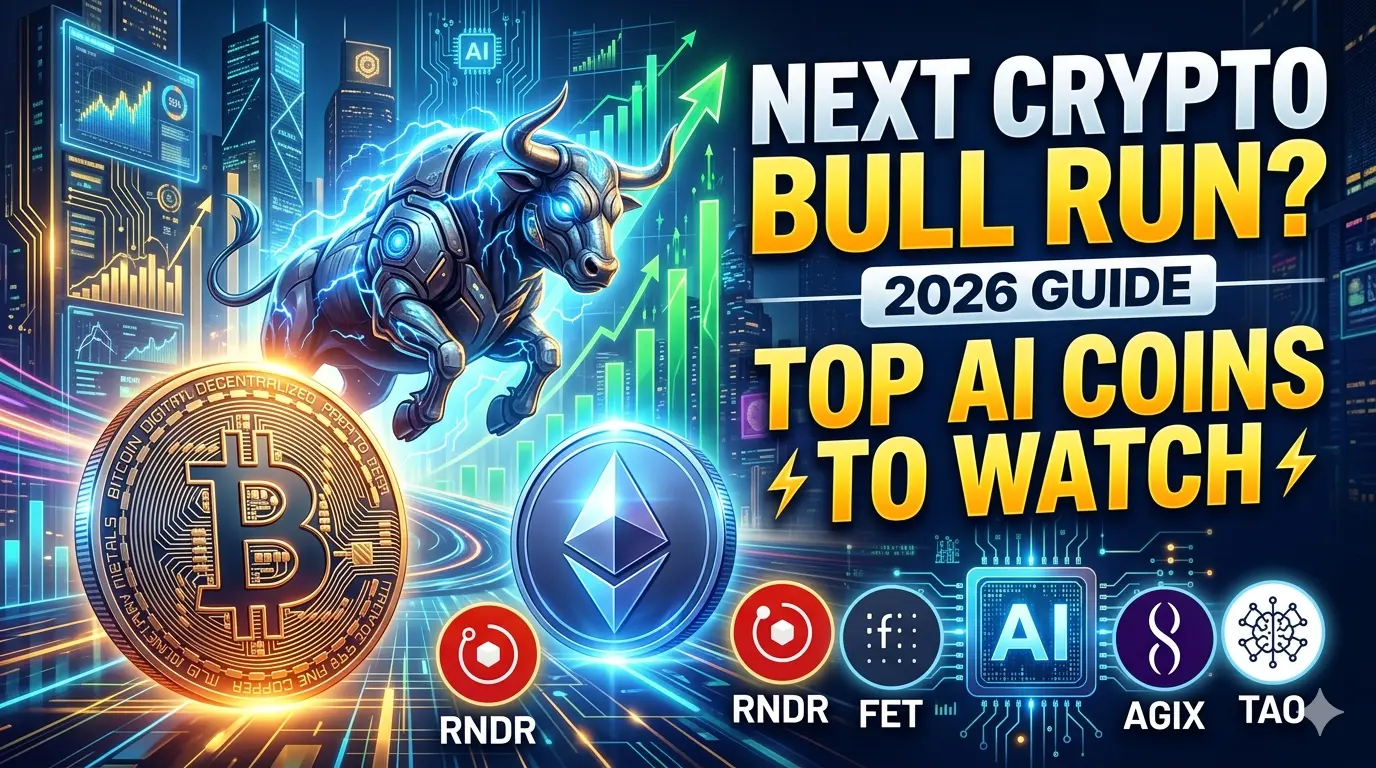
Top Crypto Coins To Watch in 2026 For Next Bull Run

Best AI Tools for Stock Market Analysis in 2026