AI Policy • United States • October 2026
U.S. Super Intelligence Force Explained: What the New AI Safety Task Force Means in 2026
The U.S. government is putting artificial intelligence safety, national security and competitiveness closer to the center of federal policy. A new White House task force—called the Super Intelligence Force—is expected to study AI risks and opportunities, coordinate federal work and recommend what role the government should play as frontier systems become more capable.
What Is the U.S. Super Intelligence Force?
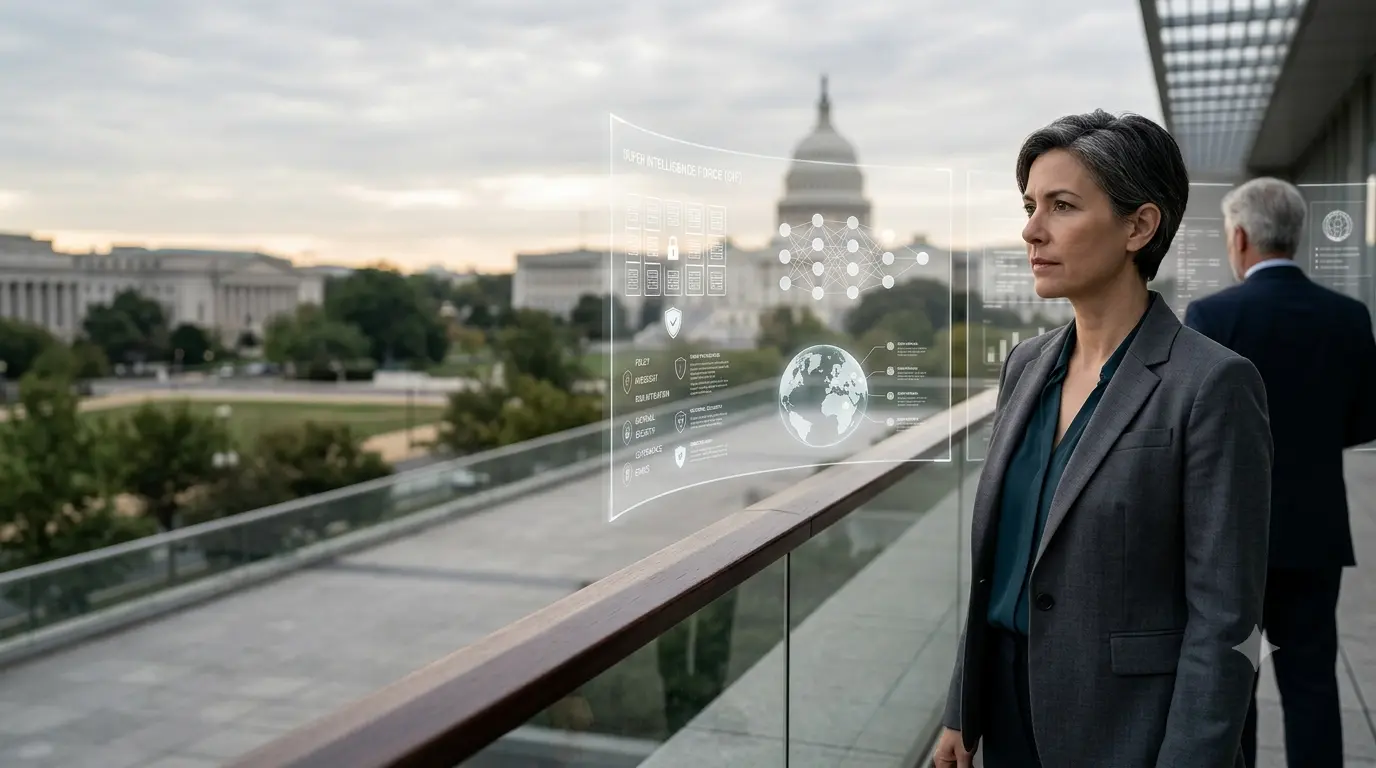
The Super Intelligence Force is a new White House task force announced in early October 2026 to coordinate federal work on advanced artificial intelligence, evaluate risks and opportunities, and help define the U.S. government's role as AI capabilities expand.
The name follows a September 29 executive order that directed the executive branch to use the terms “Super Intelligence” and “SI” in place of “Artificial Intelligence” and “AI” in official executive-branch communications. The same order instructed the Assistant to the President for Science and Technology to propose a federal definition of “Super Intelligence.”
That terminology is politically significant, but the policy questions are familiar: how should the United States protect national security, critical infrastructure and citizens while still encouraging AI innovation and maintaining a competitive edge?
In one sentence
The task force is best understood as a federal coordination and review body focused on advanced AI risks, opportunities, safety, competitiveness and the government's future role.
Why Is AI Safety Becoming a Government Priority?
AI systems are moving from chatbots into software development, cybersecurity, scientific research, defense, business operations and autonomous workflows. As these systems gain access to more tools and data, the potential benefits increase—but so do the consequences of mistakes or misuse.
Governments are therefore facing a difficult policy balance. Too little oversight can leave gaps in security, accountability and consumer protection. Too much regulation can slow deployment, raise compliance costs and potentially weaken domestic companies against international competitors.
Who Is Jay Clayton, the U.S. AI Czar?
The task force is led by Jay Clayton, who serves as Director of National Intelligence. The White House says Clayton was sworn in as the ninth Director of National Intelligence on August 3, 2026.
Clayton previously chaired the U.S. Securities and Exchange Commission and later served as U.S. Attorney for the Southern District of New York. His background combines markets, law enforcement, cybersecurity and national security—areas that overlap with many of the government's current AI concerns.
His role is important because placing an intelligence chief at the center of federal AI coordination signals that the debate is not only about consumer technology or software regulation. It is also about strategic capability, cyber threats, foreign adversaries and national resilience.
What Will the 120-Day AI Review Examine?
Reporting on the task force says it has 120 days to assess the risks and opportunities created by advanced AI and recommend what responsibility the federal government should have.
That does not automatically mean a new law or a new regulator will appear after 120 days. The review can instead produce recommendations on voluntary standards, federal coordination, procurement rules, cybersecurity response, safety testing, reporting requirements or future legislation.
Why the review matters
A federal review can influence how agencies work with AI companies even before Congress passes new legislation. Procurement standards, security requirements, incident reporting and federal guidance can all shape industry behavior.
What AI Risks Is the U.S. Government Looking At?
The public debate around the new U.S. AI safety task force spans several categories rather than one single “AI risk.”
1. Cybersecurity and malicious use
AI can assist security teams with analysis, code review and threat detection. The same capabilities can potentially help attackers automate reconnaissance, generate malicious code or scale social-engineering campaigns. Government policy therefore has to consider both defensive and offensive uses.
2. Critical infrastructure
As AI becomes integrated into energy, communications, logistics, finance and public services, failures or attacks involving those systems can have consequences beyond the software itself.
3. National security and adversarial misuse
One of the task force's core concerns is expected to be how rival states and other hostile actors could use advanced models. This makes AI national security policy central to the discussion.
4. Jobs and economic disruption
AI may improve productivity, but governments are also watching how automation changes hiring, wages, job design and demand for different skills. The policy challenge is not simply whether AI “takes jobs,” but how quickly tasks change and whether workers can adapt.
5. Privacy, fraud and public safety
Voice cloning, deepfakes, identity fraud and automated persuasion create risks for consumers and institutions. AI safety policy may increasingly intersect with existing privacy, fraud and consumer-protection rules.
6. Frontier-model safety
As leading systems become more autonomous and capable, policymakers are debating independent evaluations, internal safety controls, incident response and governance standards for frontier models.
Will the Super Intelligence Force Lead to Strict AI Regulation?
Not necessarily. The current U.S. approach emphasizes two goals that can pull in different directions: protecting national interests and keeping American AI companies competitive.
The administration has repeatedly argued against excessive regulation that could slow innovation. At the same time, the creation of a federal task force shows that Washington does not intend to treat powerful AI as an ordinary software category.
A likely near-term direction is a mixture of industry-led safety practices, federal guidance, national-security requirements and targeted oversight rather than one single comprehensive AI law.
Important distinction
AI safety and AI regulation are not identical. Safety can include testing, cybersecurity controls, model evaluations and incident response without necessarily creating broad new legal restrictions.
What Could This Mean for OpenAI, Google, Meta, Nvidia, Anthropic and xAI?
Leading AI companies are likely to feel the effects first because they build the models, chips and infrastructure that shape the frontier of the market.
For model developers such as OpenAI, Anthropic, Google and xAI, the biggest questions include how safety evaluations are performed, how major incidents are disclosed, what internal controls are expected and how governments assess frontier capabilities.
For Meta and other open-model advocates, policy around open-weight AI may be especially important. Governments want the benefits of open ecosystems while also managing risks from models that can be downloaded, modified and redistributed.
For Nvidia and other infrastructure providers, the policy discussion also intersects with compute capacity, data centers, export controls, energy demand and national security.
| Area | Possible policy focus | Why it matters |
|---|---|---|
| Frontier models | Safety evaluations and governance | Could shape how high-capability systems are tested before or after deployment |
| Cybersecurity | Security controls and incident response | AI labs hold valuable models, training data and infrastructure |
| Open models | Safety standards for open-weight systems | Balancing innovation with misuse risk is harder when weights are widely available |
| Compute | Infrastructure, chips and data centers | Advanced AI depends on large-scale compute and energy |
| Government use | Procurement and security requirements | Federal buying power can set de facto standards for vendors |
What Does U.S. AI Policy Mean for Everyday Users and Businesses?
Most people will not notice the task force directly. The impact is more likely to arrive through the products they use.
Businesses may face clearer requirements around AI security, data handling, risk management and vendor assessment. Companies selling AI to government agencies or critical industries may face higher standards than ordinary consumer applications.
Everyday users could benefit from stronger protections against fraud, unsafe systems and deceptive content—but overly broad rules could also reduce access to new tools or slow product launches.
That is why the debate over AI safety vs AI innovation matters. The most effective policy will need to reduce real harm without treating every AI application as equally risky.
Why U.S.-China AI Competition Is Part of the Story
American AI policy is increasingly shaped by strategic competition with China. U.S. officials want domestic companies to remain leaders in advanced models, chips, research and infrastructure while preventing sensitive capabilities from strengthening adversaries.
This creates a policy tension. Strict domestic rules can improve safety but could also increase costs for U.S. firms. Weak rules can speed innovation but may create security gaps or undermine trust.
The Super Intelligence Force therefore sits at the intersection of AI governance, national security and industrial strategy—not just consumer regulation.
What Should You Watch Next?
The task force is new, so many of the most important details will become clearer over the coming months. The next signals to watch include:
- whether the 120-day review recommends new legislation or mostly voluntary standards;
- whether independent model evaluations become a standard expectation;
- how incident-reporting rules are designed;
- how open-weight AI is treated;
- whether federal procurement becomes a major enforcement tool;
- how the U.S. coordinates AI safety rules with allies;
- how national-security restrictions interact with commercial AI growth.
AI Safety Policy Reality Check
Check the statements you think are true, then reveal the explanation:
Frequently Asked Questions
What is the Super Intelligence Force?
It is a new White House task force created to coordinate federal work on advanced AI, assess risks and opportunities and recommend how the U.S. government should respond.
Who leads the U.S. Super Intelligence Force?
Director of National Intelligence Jay Clayton leads the task force and has been described as the administration's AI czar.
Why did the U.S. create a new AI task force?
The government is trying to balance AI leadership and innovation with national-security, cybersecurity, economic and public-safety concerns.
Is AI regulated in the United States?
AI is affected by existing federal and state laws, sector-specific rules and agency powers, but the United States still does not rely on one single comprehensive federal AI law covering every use case.
Will OpenAI, Google, Meta, Anthropic and xAI face new rules?
They may face new standards or expectations depending on the task force's recommendations, but the review does not by itself create new binding rules.
What are the biggest AI safety risks?
Common policy concerns include cybersecurity, misuse by adversaries, critical infrastructure, fraud, privacy, frontier-model safety, economic disruption and the reliability of highly capable autonomous systems.
Will AI regulation slow innovation?
It can if rules are too broad or costly, which is why policymakers are debating targeted, risk-based approaches and industry-led standards alongside government oversight.
Why is AI a national security issue?
Advanced AI affects cyber operations, intelligence, military capabilities, critical infrastructure, economic competitiveness and strategic rivalry between major powers.
Primary Sources and Further Reading
- The White House — Executive Order: Inaugurating the Era of Super Intelligence
- The White House — Super Intelligence Fact Sheet
- The White House — Jay Clayton, Director of National Intelligence
- Council on Foreign Relations — Five Ways to Make the New AI Task Force a Success
- TechCrunch — Trump unveils his new Super Intelligence Force
Editorial note This article reflects publicly available information as of October 9, 2026. The task force is new, and its recommendations, membership details and policy direction may change as the 120-day review proceeds.