
AI Search • Global Tech Trend 2026
AI Search Agents Are Changing Google in 2026: What It Means for Everyone
Search is no longer just a list of blue links. AI systems are beginning to research, compare, summarize, monitor topics and even take action for users. That shift could change how billions of people discover information, products, websites and businesses.

Why AI Search Agents Are One of the Biggest Search Trends of 2026
Search is changing from a place where you type a few keywords into a place where you can describe a goal. Instead of searching for “best laptop under $1,000” and manually opening ten pages, an AI-powered search system can potentially compare specifications, summarize trade-offs, check current information and refine recommendations based on follow-up questions.
Google said in 2026 that AI Mode had already surpassed one billion monthly users and that AI Mode queries were more than doubling every quarter. The company also introduced information agents designed to monitor the web in the background and report changes on topics users care about. That makes the shift bigger than a normal search-interface redesign: search is beginning to behave more like an active assistant.
Watch: AI Search Agents Explained
Watch this video for a visual explanation of how AI and modern search technologies are changing the way people discover information online.
This video complements the article with a visual overview of the topic.
Why this topic matters globally
Almost everyone uses search: students, shoppers, professionals, travelers, investors, creators and businesses. When the search interface changes, internet behavior changes with it. That is why AI search is a universal topic rather than a niche technology story.
What Is an AI Search Agent?
An AI search agent is a system that can take a broader goal, search across multiple sources, reason about what it finds, follow up on missing information and produce a more complete result than a traditional one-query search.
The key word is agent. A traditional search engine responds when you search. An agent can potentially keep working after the first request. It may monitor prices, track news, compare options, check updates or continue research in the background.
Simple example
Traditional search: “cheap flights to Tokyo.” AI search agent: “Track flights from my city to Tokyo for the next month, compare baggage rules and tell me when the total price drops below my budget.”
How AI Search Agents Work
Most AI search systems combine several technologies. A language model understands the request, search systems retrieve fresh information, ranking systems decide which sources are relevant, and the AI synthesizes the information into an answer.
More advanced agentic search adds planning. The system may break a question into sub-questions, perform multiple searches, inspect several pages, compare conflicting information and decide whether another search is needed.
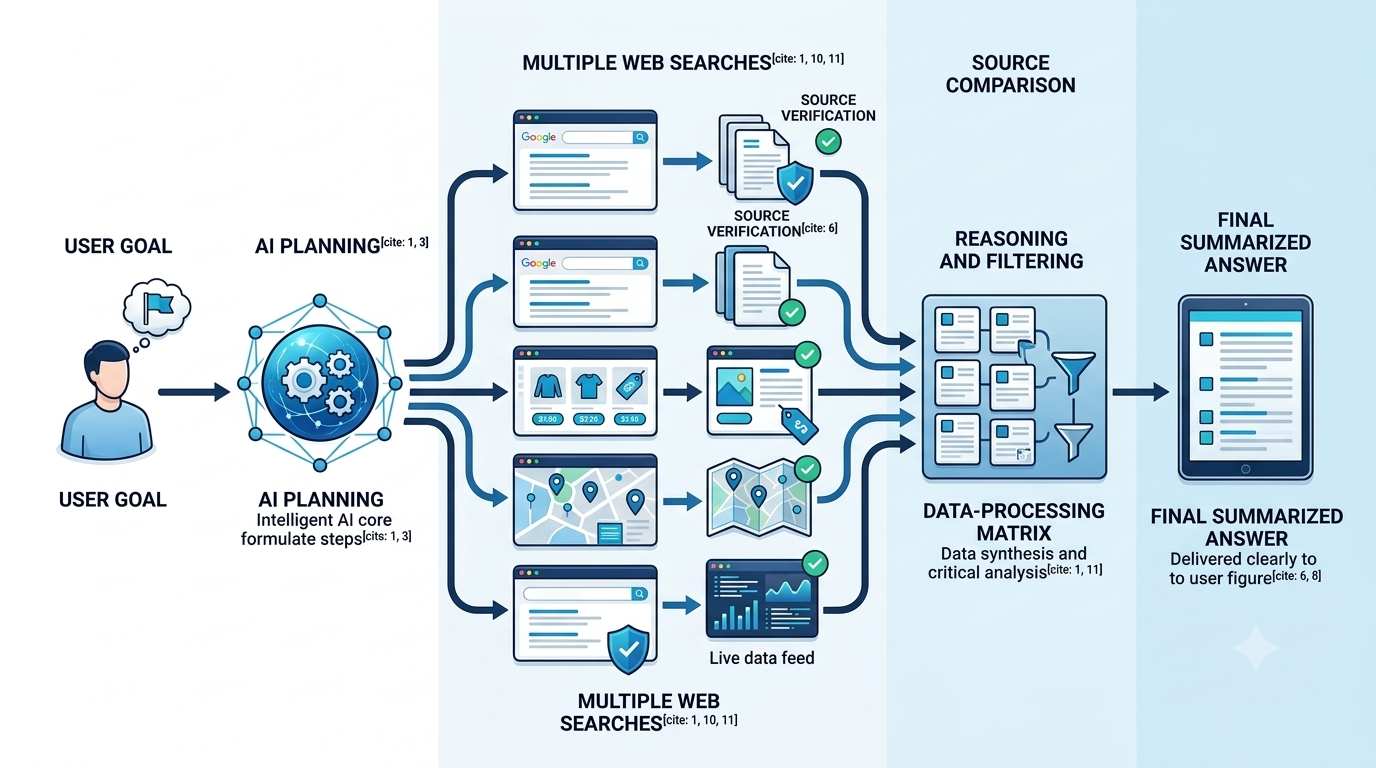
Traditional Search vs AI Search Agents
| Feature | Traditional Search | AI Search Agent |
|---|---|---|
| User input | Usually short keywords | Can handle detailed goals and natural language |
| Output | Links and snippets | Synthesized answer plus supporting sources |
| Research | User opens and compares pages | System can compare multiple sources |
| Follow-up | New search query | Conversational refinement |
| Monitoring | Manual repeated searches | Some agents can monitor topics in the background |
| Actions | Usually none | Some systems can connect research to shopping or other actions |
What AI Search Changes for Everyday Users
1. Longer questions become normal
People no longer need to compress every thought into three keywords. They can describe budget, location, preferences, constraints and goals in one request.
2. Search becomes conversational
Instead of starting from zero with every query, users can ask follow-up questions. Context can carry across the conversation.
3. Comparison becomes easier
AI search can organize large amounts of information into tables, summaries and recommendations. This is especially useful for products, travel, software, education and technical research.
4. Multimodal search grows
Search increasingly supports images, documents, video and other inputs. A person can ask about an object in a photo, upload a file or combine visual and text information in one task.
5. Repeated searches can become automated
Information agents can monitor a topic instead of forcing the user to repeat the same search every day. This could be useful for product availability, financial news, sports, travel, industry updates and other changing information.
Does SEO Still Matter When AI Answers the Question?
Yes—but the definition of strong SEO is becoming broader. Websites are no longer competing only for a blue-link ranking. They are also competing to become useful sources that AI systems can discover, understand, cite and recommend.
Google has repeatedly emphasized original, useful and trustworthy content. In 2026, the company also added features designed to highlight original sources and influential coverage inside AI-powered search experiences.
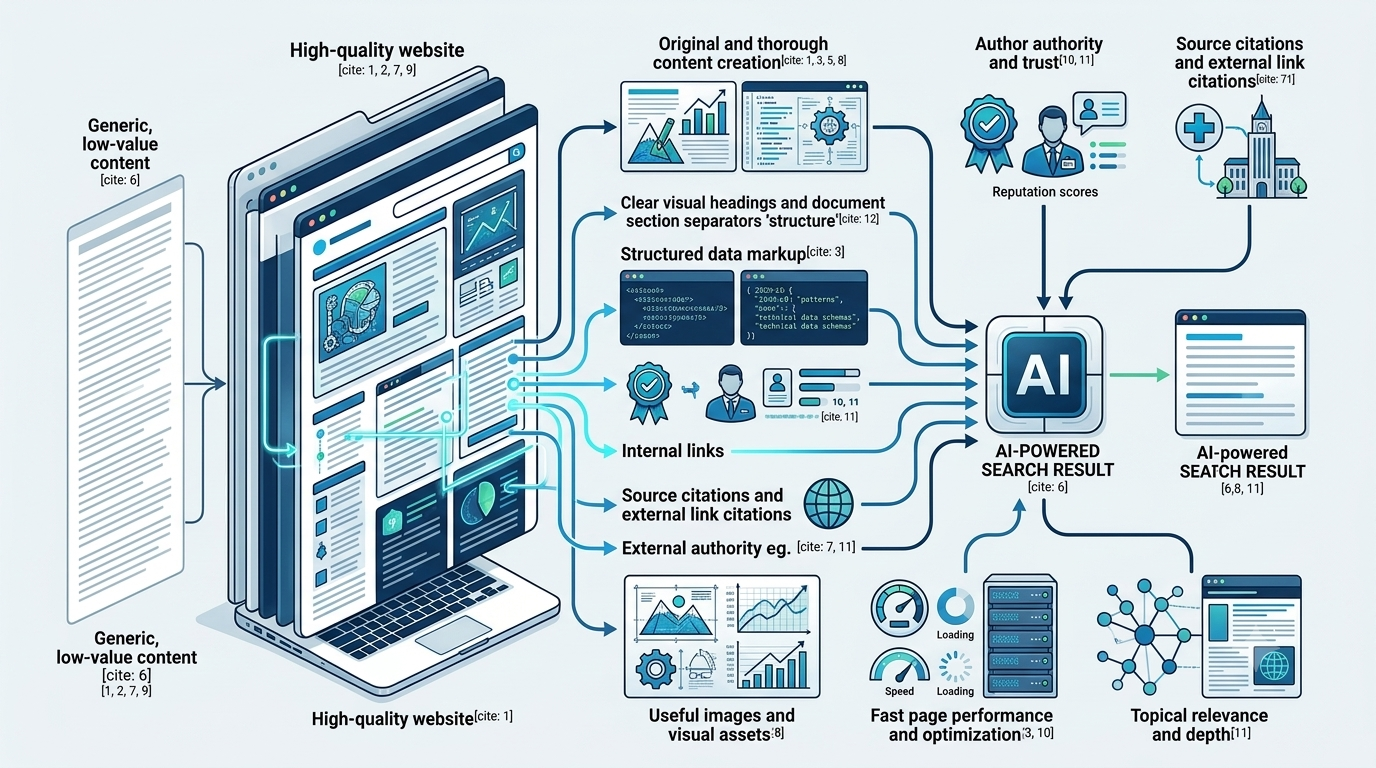
What becomes more important?
- Clear answers to real questions.
- Original information, analysis or experience.
- Strong page structure with descriptive headings.
- Accurate titles and meta descriptions.
- Relevant internal linking.
- Fast, crawlable pages.
- Author and publisher transparency.
- Reliable sources for factual claims.
- Images with useful alt text.
- Content that satisfies intent instead of merely repeating keywords.
What AI Search Means for Publishers and Websites
Publishers face both an opportunity and a challenge. If AI systems summarize information directly, some users may not need to visit every source page. On the other hand, search platforms still need fresh, trustworthy and original content to generate useful answers.
That increases the value of content that cannot be easily replaced by generic summaries. First-hand testing, expert explanations, original research, real examples, case studies, useful tools and clear opinions become more valuable.
How AI Search Could Change Shopping and Business Discovery
Product discovery is one of the areas where AI search could have the biggest effect. A user may no longer search for a product, open five stores, compare reviews manually and build a spreadsheet. An AI agent can potentially perform much of that comparison.
This means businesses should make important information easy for machines and people to understand: product names, pricing, availability, specifications, return policies, location, reviews and structured product information.
The same applies beyond ecommerce. Restaurants, software companies, service providers, travel businesses, publishers and local businesses may increasingly be discovered through conversational requests rather than exact keywords.
What Are the Risks of AI-Powered Search?
Incorrect synthesis
An AI system can combine accurate sources into an inaccurate conclusion. Users should still open primary sources when the decision is important.
Outdated information
Search agents need access to fresh data. If retrieval fails or a source has not been updated, the answer can become stale.
Source visibility
If users receive enough information directly in an AI answer, they may visit fewer websites. This creates new questions about traffic, attribution and publisher economics.
Personalization and privacy
Search becomes more useful when it understands context, but additional context can involve email, files, preferences or personal history. Users should understand what data is connected and what controls are available.
Automation mistakes
Research is one thing; taking action is another. As search agents become connected to shopping and other workflows, confirmation becomes important before purchases or high-impact actions.
How Website Owners Can Adapt to AI Search in 2026
Write for humans first
Search engines are increasingly capable of identifying pages that exist mainly to capture keywords. A useful article should solve a real problem or explain something clearly.
Target topic clusters, not isolated keywords
Instead of publishing ten unrelated pages, build a connected group of useful articles around one subject. For example, AI search, AI agents, AI privacy, AI security and AI productivity can form a strong technology cluster.
Answer long-tail questions naturally
Conversational search means longer questions matter more. Include sections that answer the way real people speak.
Make pages easy to understand
Use descriptive H2 and H3 headings, concise introductions, tables when useful, descriptive image alt text and clear internal links.
Build a recognizable source
Author pages, consistent publishing, original examples and clear editorial identity can help users recognize your site as a source rather than a collection of anonymous pages.
AI-search readiness check
Tick the improvements your article already has.
Will AI Search Kill Websites?
Probably not, but it may change which websites receive attention. Search systems still require information from the open web. Users also need source pages for detail, verification, transactions, communities, tools and original experiences.
The more realistic shift is that low-value content becomes easier to replace. If a page contains nothing beyond a generic summary, an AI-generated answer can often provide the same value faster.
Websites that provide something distinct—original data, useful tools, clear expertise, strong explanations, trusted communities or unique reporting—have a stronger reason to be visited.
What the Next Few Years Could Look Like
Search may increasingly become a layer between users and the web. Instead of visiting websites one by one, people will ask an AI system to research first and then open the most useful sources.
The search engine may also become more proactive. A user might tell it to monitor a product, topic or goal and receive an update when something important changes.
That turns search from a tool you repeatedly visit into a system that can keep working for you.
Frequently Asked Questions
What is an AI search agent?
An AI search agent is a system that can understand a goal, research multiple sources, compare information, perform follow-up searches and sometimes continue monitoring a topic in the background.
Why are AI search agents trending in 2026?
Major technology platforms are moving from simple AI answers toward agents that can research, monitor topics, compare products and handle multi-step information tasks.
Will AI search replace Google?
Google itself is integrating AI deeply into Search, so the more likely outcome is that search evolves rather than disappears.
Does SEO still matter?
Yes. Useful content, strong topical relevance, technical crawlability, original information and clear sourcing remain important for discovery.
What is agentic search?
Agentic search refers to search systems that can plan and perform multiple steps instead of answering only a single query.
Can AI search agents monitor information for me?
Some emerging search agents are designed to monitor topics and provide updates when relevant information changes.
Sources and Further Reading
Primary references
Editorial note: AI search features are evolving quickly and availability can differ by country, language and account. This article focuses on the broader direction of search and the practical implications for users, publishers and businesses.