AI Transparency • 2026
Can AI-Written Text Be Detected? How AI Watermarking Works in 2026
OpenAI has started rolling out invisible text watermarking for eligible ChatGPT and Codex outputs in the European Union. But a watermark is not a magic AI detector. Here is what it actually does, where it can fail, and what it means for students, writers, publishers, businesses and SEO.
What Changed With AI Text Watermarking in 2026?
AI text watermarking has moved from research discussions into mainstream generative AI products. OpenAI announced in October 2026 that it was beginning a phased rollout of invisible text watermarking for eligible ChatGPT and Codex outputs in the European Union.
At the same time, API customers around the world can opt in to watermarked text output on supported models.
The change is part of a wider shift toward AI content provenance: giving platforms, researchers and organizations more ways to understand whether content may have been generated by an AI system.
What makes this different?
The watermark is not a visible label, not a hidden HTML element, and not a secret character inserted into the text. The signal is created through the statistical pattern of the model's word choices.
What Is an AI Text Watermark?
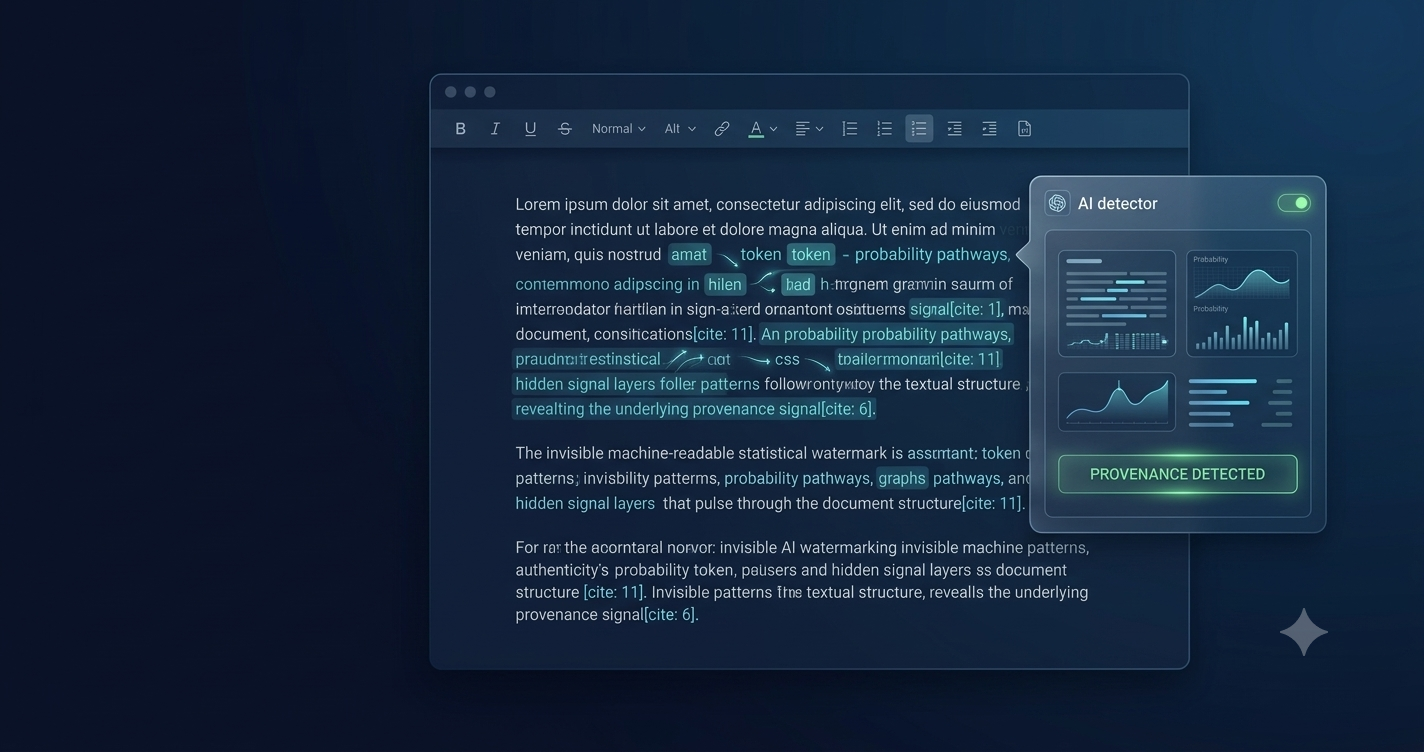
An AI text watermark is a machine-readable signal intentionally embedded while the model generates text.
A human reader normally cannot see it. The passage looks like ordinary writing. A compatible detector analyzes the pattern and estimates whether the known watermark signal is present.
This is different from metadata. Metadata can disappear when a file is copied, converted or pasted somewhere else. A statistical watermark is encoded in the wording itself, so simple copy-and-paste may preserve it.
How OpenAI's textGrain Watermark Works
OpenAI calls its text watermarking technology textGrain.
A language model often has several plausible next words or word pieces it could choose. TextGrain slightly influences those choices so that over a sufficiently long passage, a statistical pattern appears.
The result should still read naturally. The watermark does not require visible markers, unusual punctuation, invisible spaces or watermark-only words.
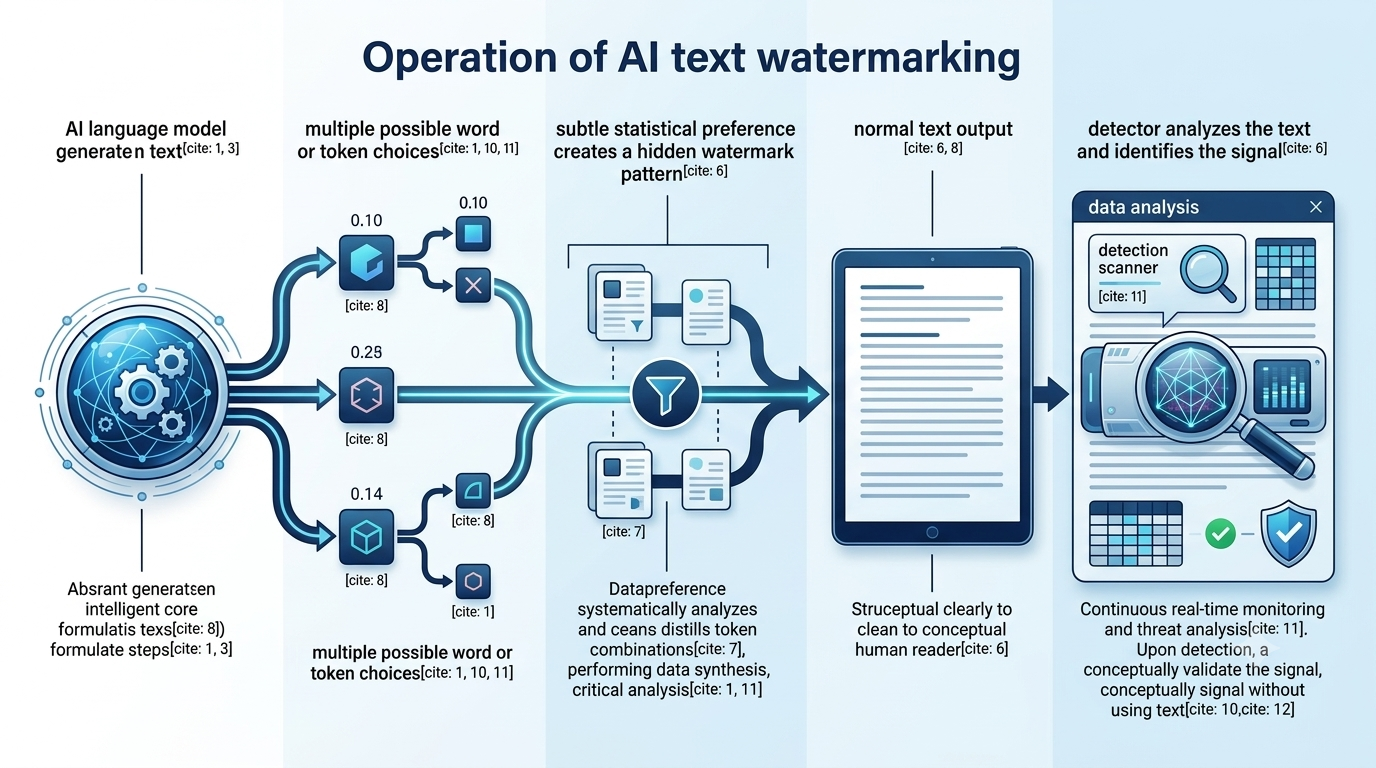
This matters because the watermark can survive normal copy-and-paste. However, it is not permanent. Large changes to the wording may weaken the original statistical signal.
AI Watermark vs AI Detector: They Are Not the Same Thing
This is one of the most important distinctions. People often say “AI detector” when they actually mean two very different technologies.
| Feature | AI Watermark | Third-Party AI Detector |
|---|---|---|
| How it works | Signal embedded during generation | Classifier analyzes text afterward |
| Needs model support | Yes | No |
| What it looks for | Known embedded pattern | Writing patterns associated with AI text |
| Can it prove authorship? | No | No |
| Can it make mistakes? | Yes | Yes |
| Works after heavy rewriting? | Less reliably | Variable |
A watermark detector looks for a signal intentionally created by the generator. A normal AI detector usually attempts to classify writing based on learned characteristics.
Can AI-Written Text Be Detected Reliably?
Not always.
Watermark detection is probabilistic. A detector can miss a watermark that exists, or report a signal where one is not actually present.
Detection also becomes harder when the passage is short. There are simply fewer word choices available to carry a strong statistical pattern.
OpenAI's current documentation also notes that detection performance varies by language. Some languages currently provide a stronger detectable signal than others.
Important limitation
A detector result should not automatically be treated as proof of cheating, plagiarism, misconduct or authorship.
What Happens If AI Text Is Rewritten or Paraphrased?
Simple copy-and-paste should preserve more of the original watermark signal because the wording remains the same.
But substantial rewriting, paraphrasing, translation or restructuring can weaken the pattern.
That means a text watermark should not be imagined as a permanent serial number. It is better understood as a statistical signal that may survive some transformations and fail after others.
What AI Watermarking Means for Students
Education is likely to be one of the areas where this technology receives the most attention.
Schools already face a difficult question: how should they distinguish legitimate AI assistance from academic misconduct?
A watermark may provide another signal, but it does not explain how the student used AI.
A student may have used AI to brainstorm ideas, improve grammar, translate a draft, summarize research or generate an entire assignment. A watermark alone cannot explain that context.
Good academic review still needs human judgment: drafts, source checks, oral explanation, revision history and evidence that the student understands what they submitted.
What It Means for Writers, Bloggers and Publishers
AI-assisted writing is becoming normal in editing, research, translation, summarization and content planning.
Watermarking does not automatically mean that AI-assisted content is low quality.
A carefully researched article can use AI as part of the workflow and still provide substantial human judgment, original analysis and editorial value.
The important question for publishers is not “Was AI ever used?” but rather: “Is this content accurate, useful, original and trustworthy?”
Does AI Watermarking Affect Google SEO?
There is currently no indication that the presence of an AI text watermark is itself a Google ranking penalty.
Google's guidance focuses on usefulness, originality, value for readers, and compliance with spam policies.
Generative AI can be useful for research, drafting and structuring content. The risk appears when websites publish large amounts of low-value pages primarily to manipulate search rankings.
That means bloggers should not focus on “beating AI detectors.” The better SEO strategy is to create content that deserves to rank.
- Answer real questions clearly.
- Add original explanation and examples.
- Use trustworthy primary sources.
- Show transparent authorship.
- Keep headings descriptive.
- Use helpful images and alt text.
- Update content when facts change.
- Avoid publishing thin pages at scale.

Why Businesses Should Care About AI Content Provenance
Companies are using generative AI for customer support, internal documents, marketing, software documentation, knowledge bases and reports.
That creates a governance question: which content came from an AI system, which content was edited by humans, and which model or workflow produced it?
Provenance signals can become one part of that governance system.
Better business practice
Combine provenance signals with human approval, version history, internal policies, access controls and audit logs.
A watermark should not be confused with a cybersecurity guarantee. Watermarked content can still be wrong, unsafe or unauthorized.
Can AI Watermarks Prove Someone Cheated?
No.
A watermark detector can indicate that a passage appears to contain a known watermark signal. It does not identify the person who generated the text.
It also cannot tell whether the person used AI for brainstorming, editing, translation, partial drafting or full generation.
This distinction is important in schools, workplaces and legal settings.
What AI Text Watermarking Cannot Tell You
- It cannot prove that a statement is factually correct.
- It cannot identify the individual who generated the text.
- It cannot prove copyright ownership.
- It cannot measure exactly how much human editing happened.
- It cannot detect every AI-generated passage.
- A missing watermark does not prove that a human wrote the text.
- It does not replace visible disclosure where disclosure is legally required.
Why AI Text Watermarking Still Matters
The internet is becoming filled with more synthetic text, images, audio and video.
That makes provenance increasingly important.
No single technology will solve every authenticity problem. The likely future is a layered system combining watermarks, metadata, platform records, disclosure rules and verification tools.
The purpose is not to make all AI-generated content suspicious. The goal is to make origin easier to understand.
Quick Reality Check
AI Detection Claim Checker
Tick any claims you have heard.
Frequently Asked Questions
Does ChatGPT add a watermark to text in 2026?
OpenAI is rolling out invisible text watermarking to eligible ChatGPT and Codex text output in the European Union. API customers globally can opt in on supported models.
Can I see the AI watermark?
No. The textGrain watermark is invisible because it is encoded through statistical patterns in word choices.
Does copy-paste remove the watermark?
Not necessarily. Because the signal is carried by the wording, ordinary copy-and-paste can preserve it.
Can paraphrasing remove or weaken it?
Heavy rewriting, paraphrasing and translation can make detection less reliable.
Are third-party AI detectors the same as watermark detectors?
No. Third-party detectors usually classify writing patterns after generation. A watermark detector searches for a specific signal intentionally embedded during generation.
Does Google penalize AI-generated content?
Google focuses on quality, usefulness and compliance with spam policies. AI use itself is not an automatic penalty, but large-scale low-value content can violate spam rules.
Can a watermark prove a student cheated?
No. It cannot identify the student, explain how the AI was used, or prove academic misconduct by itself.
Sources and Further Reading
Primary references
Editorial note: AI provenance technology is developing quickly. Product availability, supported models and detector access may change. This article reflects publicly available information as of October 6, 2026.