Gen AI vs AI Agents vs Agentic AI: Key Differences, Examples & Use Cases
Generative AI creates. AI Agents act. Agentic AI pursues goals across changing multi-step workflows. That one-line model is useful—but the real differences are in planning, tool use, memory, autonomy, feedback loops and how much responsibility the system takes on.
Prompt → generate or transform content.
Goal → use tools → complete a bounded task.
Objective → plan → act → evaluate → adapt.
Gen AI vs AI Agents vs Agentic AI: The 30-Second Answer
Generative AI produces or transforms content in response to an input. AI Agents combine models with tools, memory and an execution loop to complete a defined task. Agentic AI describes the broader goal-oriented approach in which one or more agents can plan, take actions, evaluate results and adapt as conditions change.
The biggest mistake is treating these three terms as a simple “basic → advanced → most advanced” ladder. In reality, they solve different problems. A generative model can be exactly the right choice for drafting a report. An AI Agent is better when the system must query live data or perform an action. Agentic AI becomes useful when the objective is multi-step, dynamic and cannot be reduced to one predefined path.
Another common mistake is saying Agentic AI always means “multiple agents.” It does not. A single well-designed agent can behave agentically. Multi-agent systems are one possible architecture, not the definition of Agentic AI.
Generative AI vs AI Agents vs Agentic AI: Full Comparison
| Dimension | Generative AI | AI Agent | Agentic AI |
|---|---|---|---|
| Primary purpose | Create or transform content | Complete a defined task | Pursue a broader goal across a changing workflow |
| Typical input | Prompt or context | Task or bounded goal | Objective, constraints and environment |
| Typical output | Text, image, code, audio, summary | Task result plus actions taken | Progress toward an objective, often through many actions |
| Tool use | Optional; depends on the application | Usually central | Usually extensive and dynamic |
| Memory | May use session/context memory | Often keeps task state | May maintain persistent state across longer workflows |
| Planning | Limited or prompt-level | Short-horizon task planning | Longer-horizon planning and replanning |
| Autonomy | Usually reactive | Moderate and bounded | Variable, potentially high but should remain governed |
| Feedback loop | User usually evaluates output | Can inspect tool results and retry | Continuously evaluates progress and adapts strategy |
| Number of agents | Not applicable | Usually one task agent | Can be one or many agents |
| Best fit | Creation, summarization, transformation | Automation of a clear task | Complex goals with changing conditions |
| Main risk | Hallucinated or low-quality output | Incorrect tool actions | Error propagation across autonomous workflows |
What Is Generative AI?
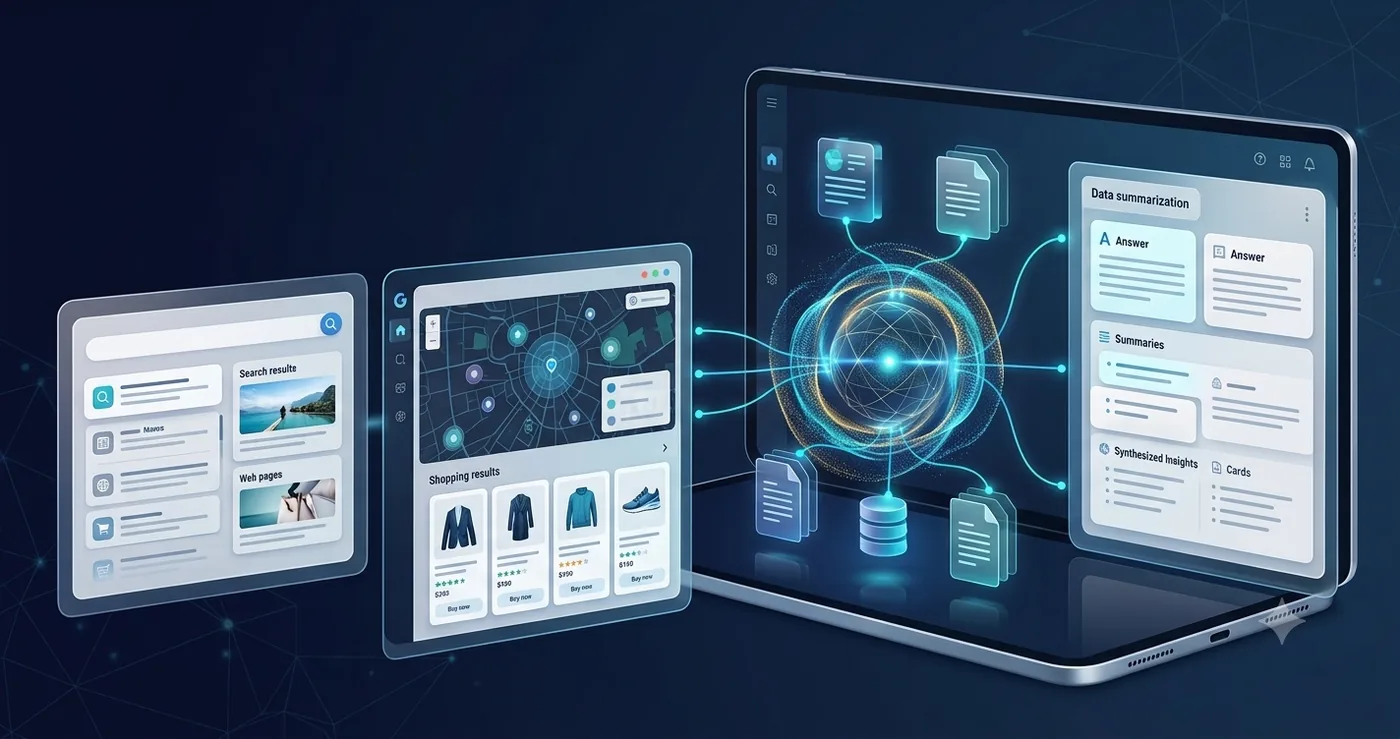
Generative AI refers to AI systems that create or transform content based on patterns learned from data and the context supplied at runtime. The output can be text, code, images, audio, video, structured data or a transformation of existing content.
Its default interaction is reactive: a user or another system provides input, the model generates an output, and the process stops until another instruction arrives. That makes Generative AI excellent for drafting, rewriting, summarizing, brainstorming, translation, code generation and document analysis.
Generative AI examples
- Drafting an email from bullet points.
- Summarizing a 50-page document.
- Creating an image from a text prompt.
- Generating code from a natural-language specification.
- Rewriting a product description for a different audience.
What Is an AI Agent?
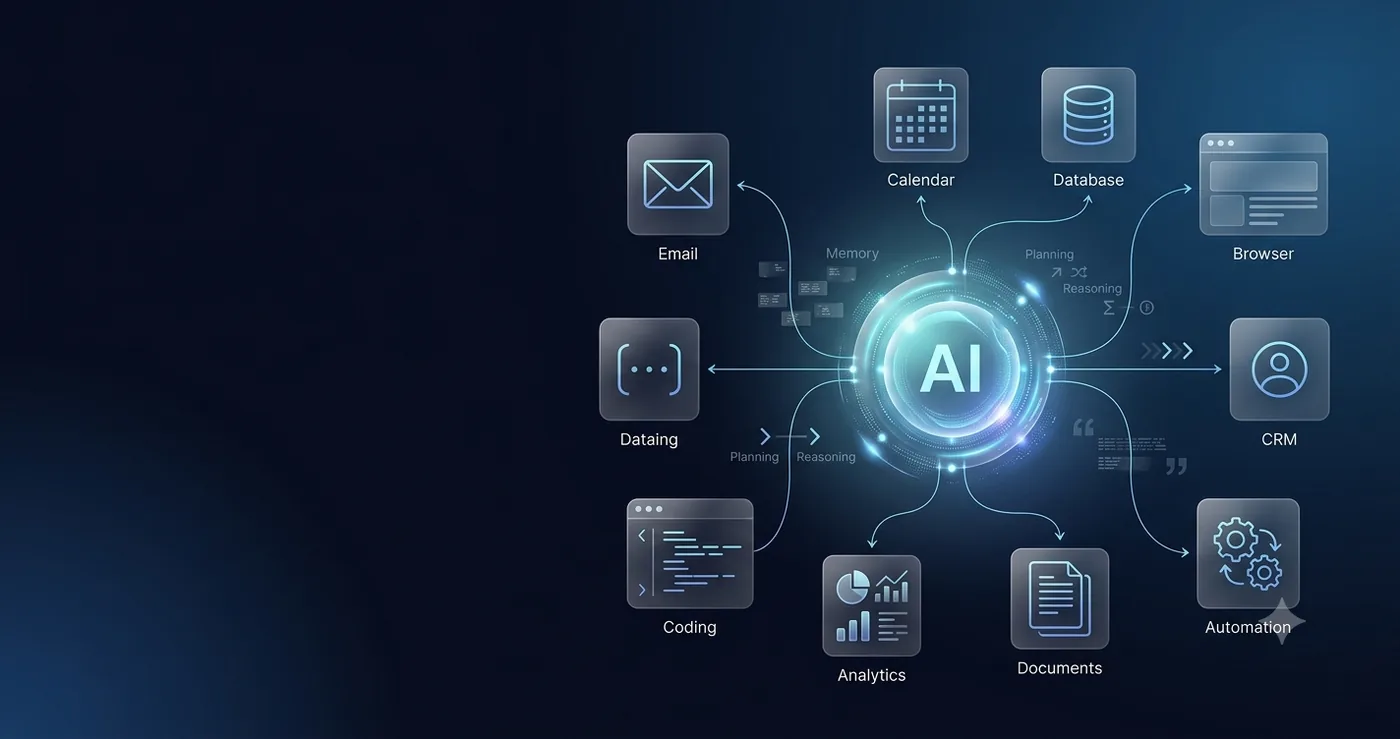
An AI Agent is a system designed to perceive context, decide what to do next and take actions toward a task or goal. Modern LLM-based agents often combine a language model with tools, task state, memory, rules and an execution loop.
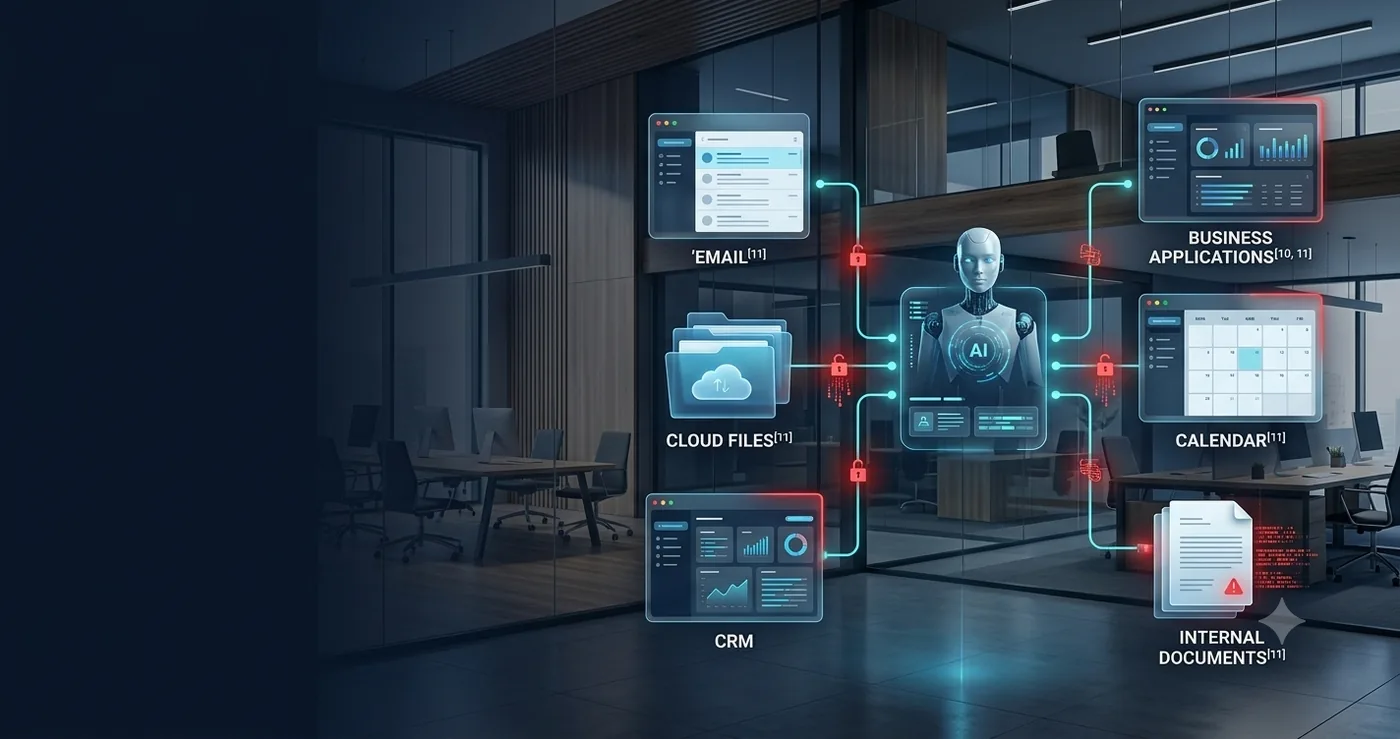
Instead of returning only an answer, an agent can call an API, search a knowledge source, run code, query a database, update a record or trigger another system. It then uses the result of that action to decide the next step.
A practical AI Agent loop
- Receive a task.
- Inspect the available context.
- Choose a next action.
- Use an approved tool.
- Observe the result.
- Retry, adjust or finish.
This loop is what separates a true task-performing agent from a chatbot that merely describes what a human should do.
What Is Agentic AI?
Agentic AI is the broader design approach in which AI systems are given enough planning, decision-making, tool access and feedback to pursue an objective with less step-by-step human direction. The system can adapt its strategy when new information appears or when a previous action fails.
The important word is agency: how much responsibility the system takes for deciding the next step. Agentic systems typically have a goal, an execution loop, tools, memory or state, validation, stopping conditions and some form of human oversight.
Agentic AI can be implemented with a single agent. More complex systems may orchestrate multiple specialized agents, but the number of agents is not the defining feature.
Agentic AI examples
- A research system that plans a topic, gathers sources, detects evidence gaps, searches again and produces a cited report.
- A coding workflow that inspects a repository, plans a change, edits files, runs tests, fixes failures and prepares a pull request.
- A business operations system that monitors a queue, resolves routine cases, escalates exceptions and changes its route when a connected service is unavailable.
Architecture: Model vs Agent vs Agentic System
Prompt → Model → Output
Model + Tools + State + Loop
Goal + Planning + Agents/Tools + Evaluation + Governance
The model is the reasoning and generation engine. An agent wraps that model with capabilities to interact with the environment. An agentic system adds the wider control structure required to keep work moving across longer and more uncertain processes.
That wider structure usually includes orchestration, permission controls, retries, validation, memory, observability and human approval. This is why production Agentic AI is an engineering problem, not just a prompting problem.
Same Real-World Task: How the Three Behave Differently
Imagine the user says: “Plan a 5-day business trip to Singapore next month under a fixed budget.”
Generative AI
It can create a sample itinerary, suggest neighborhoods, estimate a rough budget and draft a checklist. If it does not have live tools, the user must verify prices and availability separately.
AI Agent
An agent can query live flight and hotel data, compare options within the budget, check the calendar and return a ranked list. The task is bounded: find suitable options and report them.
Agentic AI
An agentic system can interpret the broader objective, plan the trip, coordinate flight/hotel/calendar constraints, revise the plan when prices change, request approval before booking, then continue with transport, meeting preparation and expense documentation.
The distinction is not that one system is “smarter.” The distinction is how much of the workflow it owns.
5 Common Misconceptions About Gen AI, AI Agents and Agentic AI
1. “Generative AI cannot use tools.”
Too absolute. A base generative model does not inherently have external access, but applications can connect generative models to tools. Tool access alone does not make the whole system Agentic AI.
2. “AI Agents only follow fixed rules.”
That describes some traditional agents and automations, but modern LLM-based agents can choose tools, reason over observations and adapt within bounded objectives.
3. “Agentic AI always means multiple agents.”
No. A single agent can operate agentically. Multi-agent orchestration is one architecture for larger systems.
4. “More autonomy is always better.”
More autonomy increases both capability and risk. If the workflow can be solved with a prompt or a deterministic automation, adding an autonomous loop may make the system harder to test and more expensive.
5. “Agentic AI learns permanently from every action.”
Not necessarily. A system can adapt within a task using memory and feedback without permanently retraining the underlying model.
When Should You Use Generative AI, an AI Agent or Agentic AI?
| If your problem looks like this… | Best starting point | Why |
|---|---|---|
| Create, summarize, rewrite or explain information | Generative AI | No autonomous action is required |
| Fetch data and perform a clear bounded task | AI Agent | Tool use and task state add real value |
| Complete a multi-step workflow with changing conditions | Agentic AI | Planning and adaptation are necessary |
| High-risk irreversible action | Human-controlled workflow | Autonomy should be constrained by approvals |
| Simple deterministic process | Traditional automation | An LLM may add unnecessary uncertainty |
The best architecture is usually the least autonomous system that reliably finishes the job. This reduces cost, makes testing easier and limits the damage from mistakes.
Risks and Governance: Why the Difference Matters in Production
Generative AI errors are often content errors: hallucinated facts, weak reasoning or inappropriate output. Agent errors can become action errors because the system can call tools. Agentic AI increases the potential blast radius because a wrong assumption can propagate across several steps before a human notices.
- Least privilege: give an agent only the tools and data needed for the task.
- Approval gates: require human confirmation for high-impact actions.
- Logging: record tool calls, decisions and outcomes.
- Evaluation: test real tasks, failure cases and prompt-injection attempts.
- Stopping rules: define when the system must pause or escalate.
Production Agentic AI is not “turn on autonomy.” It is controlled autonomy inside a measurable operating envelope.
Quick Decision Checker: Which AI Approach Fits Your Task?
People Also Ask: Gen AI vs AI Agents vs Agentic AI
What is the main difference between Generative AI and AI Agents?
Generative AI primarily creates or transforms content. AI Agents go a step further by using tools and an execution loop to complete a task or take actions in external systems.
What is the difference between AI Agents and Agentic AI?
An AI Agent is an individual task-performing system. Agentic AI is the broader approach that gives AI systems planning, tool use, feedback and autonomy to pursue goals. An agentic system can contain one agent or multiple agents.
Is ChatGPT Generative AI or Agentic AI?
A basic prompt-response ChatGPT interaction is Generative AI. When a product configuration can plan, use tools and execute multi-step tasks, the surrounding system can have agentic capabilities. The classification depends on the workflow, not just the model name.
Is an AI chatbot the same as an AI Agent?
No. A chatbot is an interface centered on conversation. An AI Agent is defined by its ability to perceive context, choose actions and work toward a task. A chatbot can be connected to an agent, but not every chatbot is an agent.
Does Agentic AI require multiple AI Agents?
No. Multiple agents are optional. A single agent with planning, tool use, feedback and adaptive behavior can form an agentic workflow.
What is a simple example of Agentic AI?
A coding system that receives a bug report, inspects the repository, plans a fix, edits code, runs tests, diagnoses failures and retries before asking for review is a simple example of agentic behavior.
Frequently Asked Questions
Which is more advanced: Gen AI, AI Agents or Agentic AI?
Agentic AI generally takes on more workflow responsibility, but “more advanced” does not mean “better” for every task. Simpler systems are often safer, cheaper and easier to evaluate.
Can Generative AI become an AI Agent?
A generative model can be used as the reasoning engine inside an agent when it is connected to tools, task state, instructions and an execution loop.
Are AI Agents autonomous?
They can have bounded autonomy. A well-designed production agent should operate within defined permissions, stopping conditions and approval rules.
What is the role of memory in Agentic AI?
Memory helps an agent maintain task state, reuse previous observations and preserve relevant context across a longer workflow. Memory does not necessarily mean the base model is being retrained.
What is an agentic workflow?
An agentic workflow is a process in which AI can decide some of its next steps, use tools, inspect results, revise its plan and continue toward a goal with less step-by-step human direction.
What industries use Agentic AI?
Agentic approaches are being explored in software engineering, customer support, finance operations, sales, research, procurement, supply chain, healthcare administration and other multi-step knowledge workflows.
Final Takeaway
The cleanest way to remember Gen AI vs AI Agents vs Agentic AI is this:
- Generative AI: “Create something for me.”
- AI Agent: “Complete this task for me.”
- Agentic AI: “Achieve this goal and adapt as the situation changes.”
The future of enterprise AI will likely use all three together. A generative model can create, an agent can act, and an agentic architecture can coordinate the larger objective. The winning system is not the one with the most autonomy—it is the one with the right amount of autonomy for the job.
Primary Sources & Further Reading
- IBM — Agentic AI vs Generative AI
- GeeksforGeeks — Gen AI vs AI Agents vs Agentic AI
- Dr. D. Y. Patil School of Science & Technology — Generative AI vs AI Agents vs Agentic AI