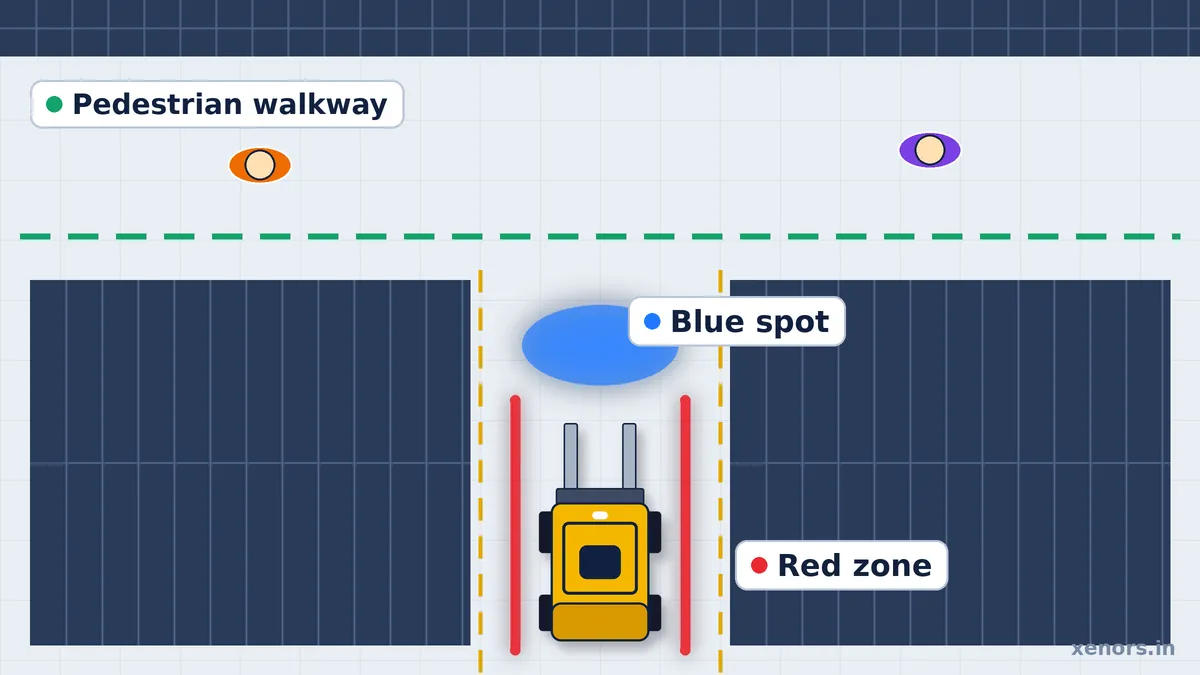
Forklift Safety Lights: Types, Blue Spot vs Red Zone & Buying Guide
Compare forklift safety lights for warehouses: blue spot, red zone, arc, arrow and LED warning lights. Explore types, installation, prices and buying tips.
Read article →A practical guide to human detection AI cameras, warehouse collision alerts, engineered stopping systems and safe installation.
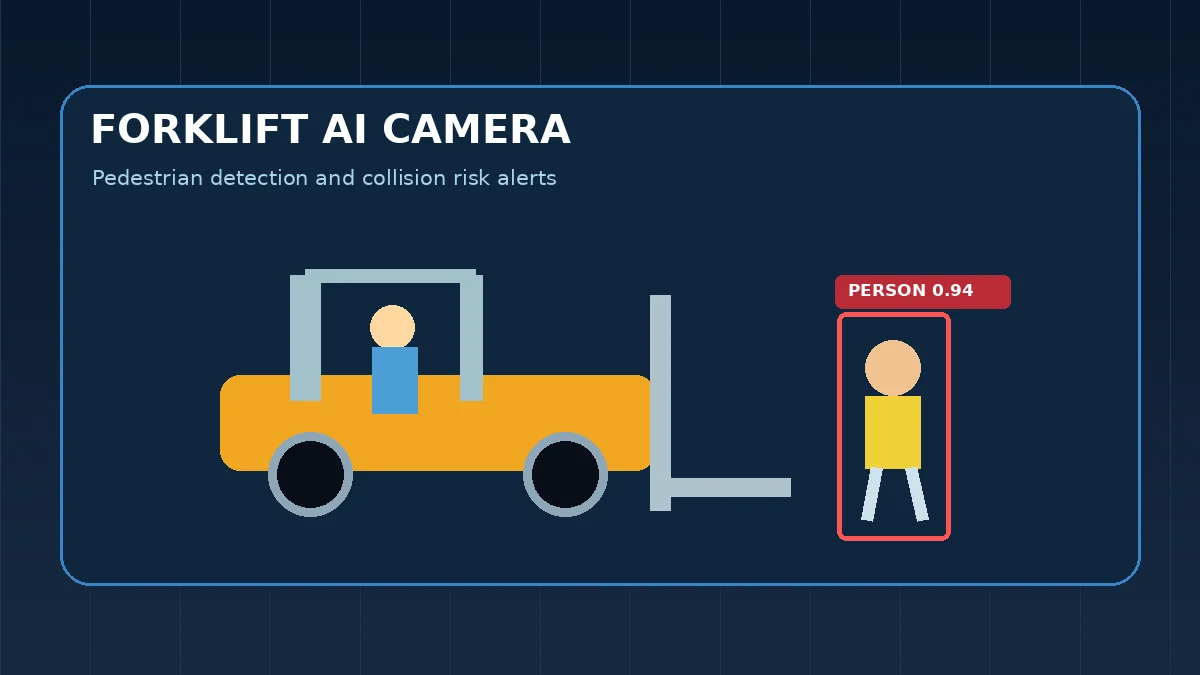
A forklift AI camera uses computer vision to identify people or selected hazards and issue warnings. An automatic stop requires additional vehicle-approved, safety-engineered controls; a camera alone is not a certified braking system.
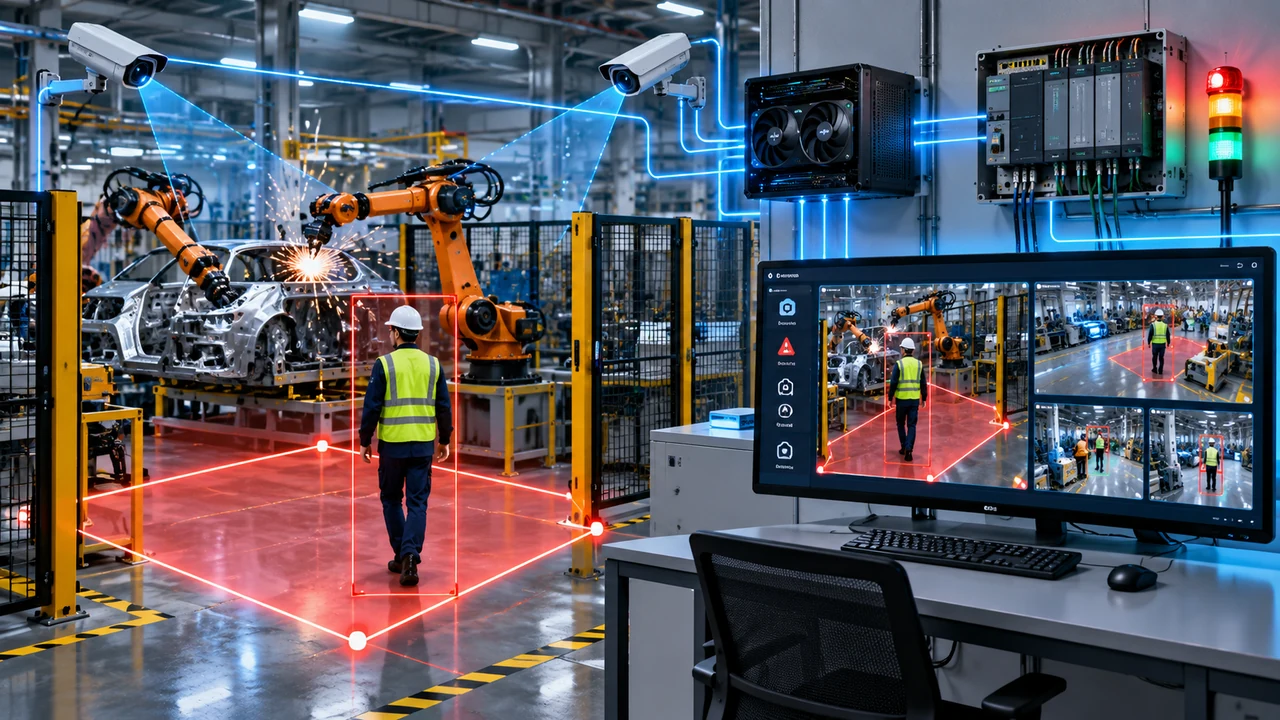
A forklift AI camera is a vision-based sensing system that analyses video from one or more cameras to identify pedestrians, vehicles or selected hazards near a moving forklift. Depending on the product, it may show an on-screen warning, sound an alarm, send an event to a fleet platform or request a controlled vehicle response through an engineered interface. The camera itself does not automatically make a truck safe.
In a warehouse, the challenge is not simply recognizing a person. A practical solution must detect people in relevant travel paths, handle partial occlusion, remain usable when the mast or load blocks the view, and avoid creating so many false alerts that operators begin ignoring them. An effective deployment combines camera positioning, risk-based zones, driver training, traffic separation and functional testing.
This guide compares forklift pedestrian detection AI cameras, forklift collision AI cameras, human detection systems and forklift auto stop systems. It explains what to ask suppliers, how to plan a pilot and which claims need evidence before a purchase.
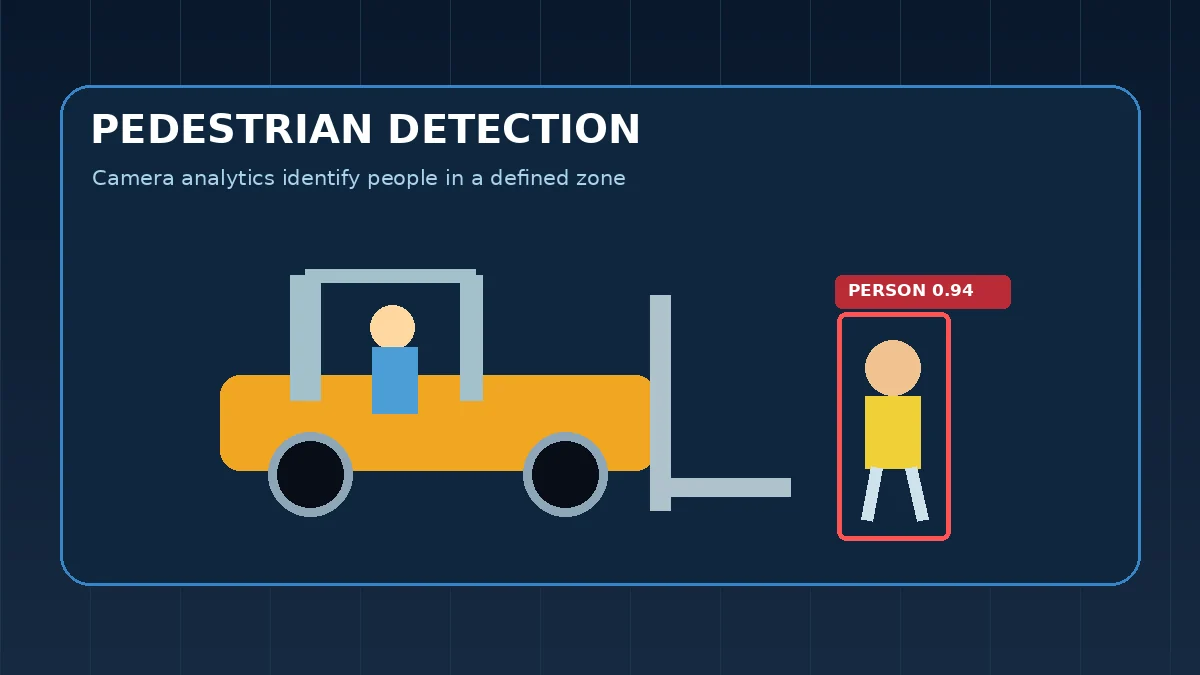
Forklifts operate among racks, pallets, loading bays, dock doors and people who may move unexpectedly. Mirrors, horns and conventional lights remain useful, but they do not always tell an operator whether a pedestrian has entered a specific area. A camera-based system can provide an additional layer of situational awareness by detecting a person in a defined field of view.
Common deployment goals include improving awareness during reversing, monitoring blind intersections, reducing near-miss exposure, recording safety events for investigation and supporting site-specific traffic rules. The value depends on how accurately the system detects the relevant hazards under actual conditions—not on a laboratory accuracy percentage alone.
AI cameras are supplementary risk controls. They do not replace physical barriers, designated pedestrian routes, speed limits, operator visibility requirements, competent supervision or established safe operating procedures.
AI detection confidence is not a certified probability of safety. A displayed 0.95 confidence score does not mean a 95% chance of avoiding a collision. Camera visibility, calibration, latency, environmental variation and failure modes must be evaluated separately.
| Solution | Primary function | Best-fit application | Key limitation |
|---|---|---|---|
| Pedestrian detection camera | Detect people in the camera view | Shared warehouse aisles | Occluded people may be missed |
| Collision warning AI camera | Warn about selected people or objects | Reversing and blind approaches | Warning alone cannot ensure a stop |
| Multi-camera surround system | Extend coverage around the vehicle | Complex manoeuvring | Calibration and synchronization are critical |
| Human detection AI system | Detect people at fixed locations | Crossings, gates, work zones | Fixed cameras cannot see all vehicle blind spots |
| Auto-stop integrated system | Request controlled stop on defined hazard | Engineered high-risk zones | Requires vehicle-specific safety assessment |
Products sold as a “forklift collision AI camera” can differ greatly. Ask whether the system detects only pedestrians or also pallets, racking and other trucks; whether it understands motion; and how it behaves when the camera is blocked or offline.
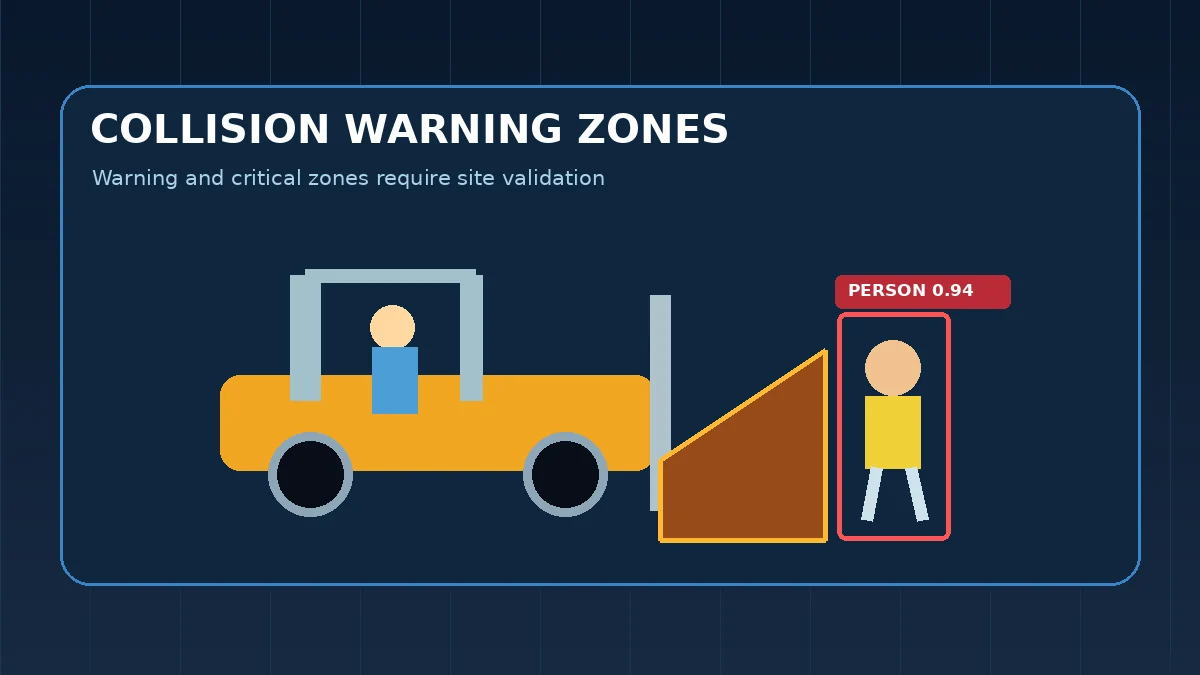
Most useful systems distinguish a monitoring zone, a warning zone and, where supported, a critical zone. The zones may be polygons in image coordinates or calibrated physical distances. A polygon on a video image is not automatically a reliable metre-based distance measurement.
Set zones using measured stopping distances, typical vehicle speed, floor conditions, operator reaction time, load characteristics and pedestrian movement. A stop zone should not be selected by copying a competitor's diagram. For example, a zone that appears large on a wide-angle camera may represent a much shorter distance near the forklift than it does farther away.
Alert design matters: a brief visual prompt may be appropriate for a distant hazard, while a distinct audible alert may be needed for immediate operator attention. Excessive beeps can create alarm fatigue. Document how long an object must remain visible before an alarm, how alerts reset and whether they repeat while the hazard remains present.
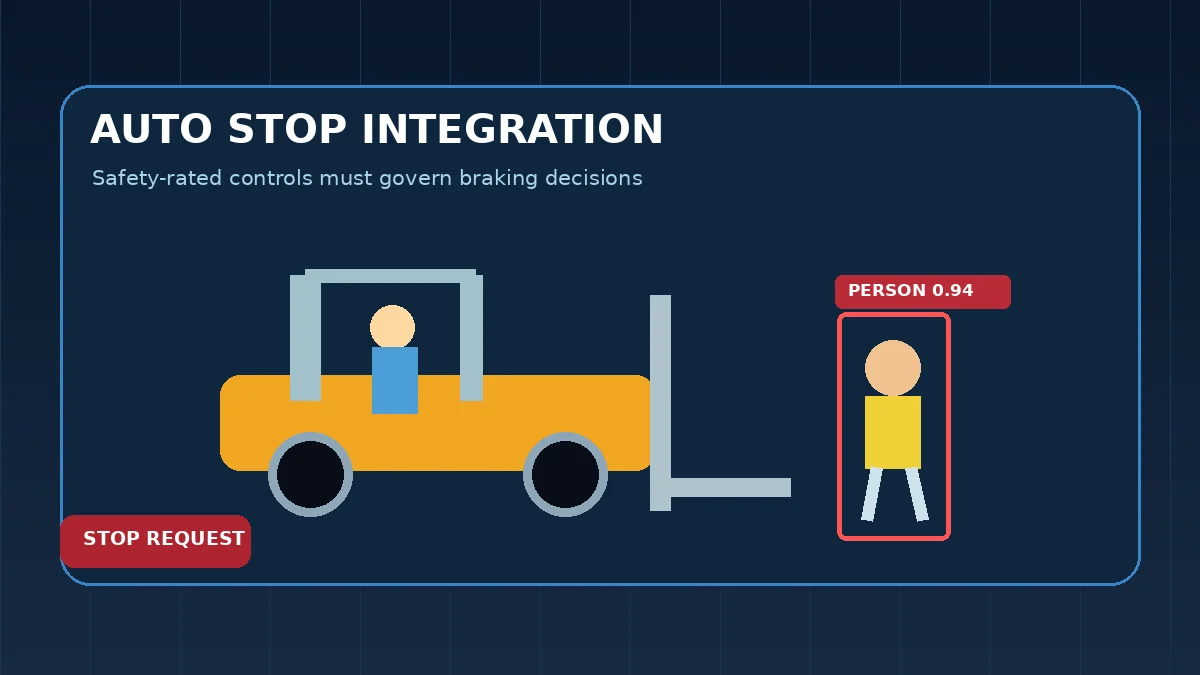
A forklift auto stop system is more than a camera connected to a relay. Stopping a moving industrial truck involves its control architecture, braking performance, drive state and the consequences of an unexpected stop. An uncontrolled stop can itself create a hazard, particularly with elevated or unstable loads.
Important: Do not wire a generic AI PC, GPIO, ESP32 or ordinary relay directly into a forklift brake or propulsion circuit and treat it as a safety function. Any automatic intervention needs manufacturer-approved interfaces, competent safety engineering, a documented risk assessment and appropriate safety-rated components where required.
For a proposed stop function, request the supplier's documented safety concept: hazard analysis, fault response, detection coverage, maximum response latency, diagnostics, restart behaviour, manual override policy, proof testing and applicable safety-performance evidence. Where a safety-related control system is involved, an assessor may consider standards such as ISO 13849-1 or IEC 62061, subject to the actual machine and jurisdiction.
It is also important to distinguish warning-only, speed reduction, controlled stop request and safety-rated protective stop. These are not interchangeable product features.
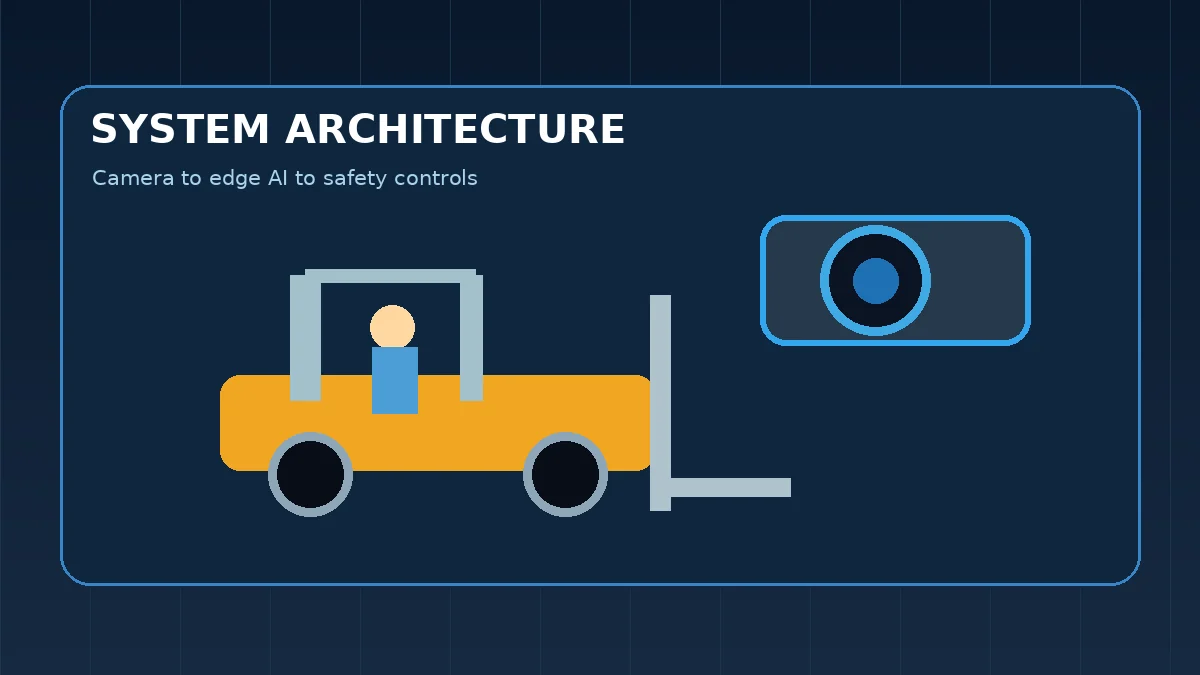
A typical implementation uses an IP or embedded camera, an edge AI compute unit, a driver display or buzzer, a health-monitoring function and an optional integration gateway. Depending on the vehicle, the system may also read ignition, reverse gear, travel direction or speed through approved interfaces.
A separately engineered, manufacturer-approved path may feed a safety controller for a permitted speed-reduction or stop function. That path needs fault monitoring and verification; the drawing above is not a safety wiring diagram.
Look for camera disconnection detection, stale-frame alarms, power-cycle recovery, event timestamp synchronization, storage limits, secure configuration access and a way to test the system without putting people in danger.
| Your operating condition | Start with | Confirm before purchase |
|---|---|---|
| Reversing near pedestrian walkways | Rear-facing pedestrian detection camera | Blind-zone coverage and alert latency |
| Frequent blind intersections | Vehicle camera plus crossing controls | Approach speed and pedestrian flow |
| Long narrow aisles | Forward camera and defined travel zones | Range, mast occlusion and lighting |
| Busy multi-directional yards | Multi-camera or complementary sensing | Weather, dust and camera cleaning |
| Mandatory automatic intervention | Vehicle-OEM-approved integrated solution | Safety validation and stop performance |
| Budget-constrained pilot | Warning-only camera with event logs | Measured missed detections and nuisance alerts |
For most first deployments, a carefully evaluated warning-only pilot is easier to validate than immediately modifying vehicle controls. A buyer should prioritize reliable hazard detection and a measurable risk reduction over the number of AI features in a brochure.
Commissioning should include cold starts, intermittent power, camera disconnection, dirty lenses, night operation and recovery after network failure. For any auto-stop function, use the vehicle manufacturer and qualified safety professionals to define the test protocol.
Supplier statements such as “99% AI accuracy” are not enough. Ask for a test definition: detection recall, precision, missed detections per operating hour, false alerts per hour, detection distance, illumination, speed, camera position and test population. A model that works in still photos may behave differently on a vibrating forklift.
Useful acceptance tests include pedestrians walking across and toward the camera, different clothing colours, high-visibility vests, partial occlusion behind pallets, people crouching, strong backlight, low light, wet floors, dusty lenses and loaded-fork visibility. Test each camera location separately.
Measure end-to-end warning latency from the first observable hazard frame to the actual audible or visible output. If an automatic vehicle response is proposed, include the complete sensor-to-controller-to-brake delay and the physical stopping distance. Do not infer braking performance from AI inference speed alone.
Agree on acceptance criteria before the pilot. The target should be tied to the site's risk assessment, not a universal percentage invented for marketing.
| Technology | What it does | What it does not guarantee |
|---|---|---|
| AI pedestrian camera | Recognizes selected objects in video | Detection through obstacles |
| Blue spot / red zone light | Projects a visible warning on the floor | Actual pedestrian detection |
| Reverse alarm / horn | Provides an audible signal | That a person hears or reacts |
| Mirror | Improves line of sight | Coverage of every blind spot |
| Proximity sensor | Detects compatible targets within its capability | Reliable classification of every person |
| Safety-rated control | Performs validated control functions | Hazard detection unless suitable sensing is included |
Layering controls can be effective: traffic separation and barriers reduce exposure, while warning lights, mirrors and AI systems can support awareness. The right combination depends on the risk assessment and the site layout.
The forklift AI camera price in India depends on whether the quote includes a camera only, an integrated edge AI device, display, buzzer, multiple cameras, mounting kits, cabling, installation, software support, event storage or vehicle integration. Automatic stopping can add significant engineering and validation work beyond a warning-only package.
Ask suppliers for an itemized quote covering hardware, installation, training, commissioning, support, warranty terms, software updates, data storage and any recurring licence. Do not compare a single-camera warning kit directly with a fully validated fleet-level system.
For budgeting, request a site survey and pilot proposal rather than relying on an unverified online starting price. No fixed price is stated here because vehicle models, safety requirements and deployment scope vary substantially.
A rear-facing camera can detect people who enter a visible reversing zone and alert the operator. A warning is still subject to camera blind spots and operator response.
AI monitoring can complement dock barriers and marked walkways when forklifts and pedestrians share limited space. Glare and transitions between indoor and outdoor light need testing.
Fixed cameras may monitor defined crossings while vehicle cameras support mobile awareness. Separate fixed and moving systems should not be assumed to share a common safety rating.
Rain, dirt, sunlight and changing backgrounds affect image quality. Environmental protection ratings describe enclosure resistance, not guaranteed AI detection performance.
Lens fogging, condensation and artificial illumination may require additional engineering. Verify the actual operating temperature and cleaning procedure.
Forklift cameras may capture employees and visitors. Define a legitimate safety purpose, notify affected people where required, limit access to footage and use proportionate retention periods. Avoid using identifiable recordings for unrelated employee monitoring without an appropriate legal and organizational basis.
Protect networked cameras with unique credentials, restricted access, supported firmware, segmented networks and secure update processes. Record configuration changes, especially those affecting detection zones or alert thresholds. A cyber incident that disables warnings is also an operational safety concern.
Regulatory requirements vary by country, truck type and application. In the United States, OSHA's powered industrial truck standard, 29 CFR 1910.178, provides a starting point for understanding operator and truck safety obligations. It does not establish that every forklift must have an AI camera.
For machine safety engineering, relevant reference frameworks may include ISO 13849-1 for safety-related control systems and IEC 62061. Applicability, edition and required performance must be assessed by qualified specialists; mentioning a standard is not evidence that a product is certified.
Do not describe a generic AI object detector as fail-safe, SIL-rated, PL-rated, certified collision prevention or guaranteed zero-accident protection without product-specific evidence.
Request references for comparable environments, but treat testimonials and demo videos as supporting information—not substitutes for an on-site acceptance test.
It is a camera-based vision system that identifies selected hazards such as pedestrians and can trigger warnings or pass signals to other systems. Its capabilities depend on the model and integration.
Video is analysed by an AI model; configured zones and rules determine when a driver warning or other approved response is requested.
No. Cameras can miss occluded or poorly visible hazards, and warnings depend on operator response. They supplement, rather than replace, established safety controls.
Some engineered solutions can request a controlled stop, but this requires vehicle-specific approval, a risk assessment and appropriate validated control integration.
Pedestrian detection classifies people in video. Collision risk assessment also considers location, travel direction, speed and stopping distance where available.
Some systems support low-light operation, but performance must be tested under the actual lighting and environmental conditions.
The number depends on the relevant blind spots, load occlusion, manoeuvring pattern and the coverage required by the risk assessment.
Price varies by camera count, compute hardware, display, installation, support and any vehicle control integration. Request an itemized quote.
Warning-only retrofits may be feasible on many vehicles after a survey. Automatic braking integration requires additional manufacturer and safety engineering review.
OSHA does not universally require AI cameras on every forklift. Applicable obligations depend on the operation and the powered industrial truck safety requirements.
A well-designed system should detect the fault, indicate loss of protection and follow a documented operating procedure; do not assume a failed camera continues to protect people.
No. Blue spot lights project a warning onto the floor, while AI cameras analyse video to detect selected hazards.
Test visibility, missed detections, nuisance alerts, warning latency, camera faults, environmental conditions and operator understanding in a controlled pilot.
No. Operators still require training, safe speeds, clear pedestrian routes and adherence to site traffic rules.
A good forklift pedestrian detection AI camera can make hazards more visible and help operators respond sooner. A good forklift collision AI camera is not simply the one with the largest advertised detection range; it is the one that performs consistently in the exact operating conditions and provides understandable warnings with documented failure behaviour.
For facilities considering a forklift auto stop system, the next step is a vehicle-specific engineering assessment, not a direct relay connection. Start with a traffic-risk review, pilot the detection system, measure its performance and commission any vehicle intervention only through an approved safety-control process.
For complementary warehouse controls, read our forklift safety lights guide, which compares blue spot, red zone and other projected warning lights.
Define your site hazards, camera coverage and acceptance criteria first. Ask for a technical discussion and an itemized proposal—not unsupported zero-accident promises.
Discuss an industrial AI safety solution ↗Commercial link to Hesham Industrial Solutions. Availability and specifications require direct confirmation.Standards and guidance are cited for context; no product certification is implied.
Continue exploring