
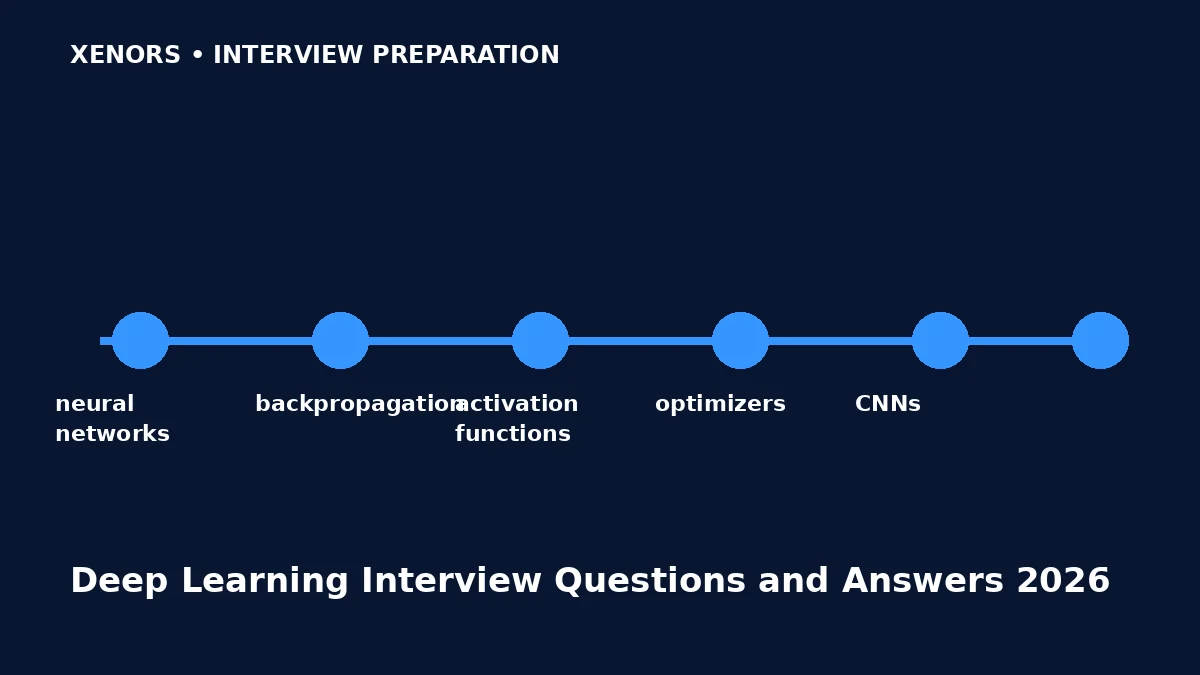
This guide targets deep learning interview questions and related medium-tail searches. It is organized for interview preparation: quick explanations, model-answer structure, production trade-offs, common mistakes and a short revision plan.
How to answer technical interview questions
Use a four-part pattern: define the concept, explain why it matters, give a concrete example, then mention a trade-off or failure mode. This is stronger than memorizing long definitions because it shows practical judgment.
Core Deep Learning Interview Questions and Answers 2026 questions and model-answer guidance
1. What is neural networks and why does it matter?
Define neural networks in plain English first. Then connect it to the wider Deep Learning Interview Questions and Answers 2026 workflow: what problem it solves, where it sits in the pipeline, and what can go wrong. A useful interview answer gives one example and one limitation. Avoid stopping at a textbook sentence; show that you know how the concept behaves with real data, imperfect inputs, production constraints and measurable outcomes.
2. How would you explain neural networks to a non-technical stakeholder?
Start with the requirement, constraints and success metric before naming tools. For a Deep Learning Interview Questions and Answers 2026 problem involving neural networks, describe the data or input contract, the core processing stages, evaluation, failure handling, observability and deployment. Then explain what you would simplify for a prototype and what you would add for production. Interviewers want to hear trade-offs: quality versus latency, accuracy versus cost, offline metrics versus user outcomes, and how you would debug the system when performance drops.
3. How would you evaluate or test neural networks in a real project?
Start with the requirement, constraints and success metric before naming tools. For a Deep Learning Interview Questions and Answers 2026 problem involving neural networks, describe the data or input contract, the core processing stages, evaluation, failure handling, observability and deployment. Then explain what you would simplify for a prototype and what you would add for production. Interviewers want to hear trade-offs: quality versus latency, accuracy versus cost, offline metrics versus user outcomes, and how you would debug the system when performance drops.
4. What is backpropagation and why does it matter?
Define backpropagation in plain English first. Then connect it to the wider Deep Learning Interview Questions and Answers 2026 workflow: what problem it solves, where it sits in the pipeline, and what can go wrong. A useful interview answer gives one example and one limitation. Avoid stopping at a textbook sentence; show that you know how the concept behaves with real data, imperfect inputs, production constraints and measurable outcomes.
5. How would you explain backpropagation to a non-technical stakeholder?
Start with the requirement, constraints and success metric before naming tools. For a Deep Learning Interview Questions and Answers 2026 problem involving backpropagation, describe the data or input contract, the core processing stages, evaluation, failure handling, observability and deployment. Then explain what you would simplify for a prototype and what you would add for production. Interviewers want to hear trade-offs: quality versus latency, accuracy versus cost, offline metrics versus user outcomes, and how you would debug the system when performance drops.
6. How would you evaluate or test backpropagation in a real project?
Start with the requirement, constraints and success metric before naming tools. For a Deep Learning Interview Questions and Answers 2026 problem involving backpropagation, describe the data or input contract, the core processing stages, evaluation, failure handling, observability and deployment. Then explain what you would simplify for a prototype and what you would add for production. Interviewers want to hear trade-offs: quality versus latency, accuracy versus cost, offline metrics versus user outcomes, and how you would debug the system when performance drops.
7. What is activation functions and why does it matter?
Define activation functions in plain English first. Then connect it to the wider Deep Learning Interview Questions and Answers 2026 workflow: what problem it solves, where it sits in the pipeline, and what can go wrong. A useful interview answer gives one example and one limitation. Avoid stopping at a textbook sentence; show that you know how the concept behaves with real data, imperfect inputs, production constraints and measurable outcomes.
8. How would you explain activation functions to a non-technical stakeholder?
Start with the requirement, constraints and success metric before naming tools. For a Deep Learning Interview Questions and Answers 2026 problem involving activation functions, describe the data or input contract, the core processing stages, evaluation, failure handling, observability and deployment. Then explain what you would simplify for a prototype and what you would add for production. Interviewers want to hear trade-offs: quality versus latency, accuracy versus cost, offline metrics versus user outcomes, and how you would debug the system when performance drops.
9. How would you evaluate or test activation functions in a real project?
Start with the requirement, constraints and success metric before naming tools. For a Deep Learning Interview Questions and Answers 2026 problem involving activation functions, describe the data or input contract, the core processing stages, evaluation, failure handling, observability and deployment. Then explain what you would simplify for a prototype and what you would add for production. Interviewers want to hear trade-offs: quality versus latency, accuracy versus cost, offline metrics versus user outcomes, and how you would debug the system when performance drops.
10. What is optimizers and why does it matter?
Define optimizers in plain English first. Then connect it to the wider Deep Learning Interview Questions and Answers 2026 workflow: what problem it solves, where it sits in the pipeline, and what can go wrong. A useful interview answer gives one example and one limitation. Avoid stopping at a textbook sentence; show that you know how the concept behaves with real data, imperfect inputs, production constraints and measurable outcomes.
11. How would you explain optimizers to a non-technical stakeholder?
Start with the requirement, constraints and success metric before naming tools. For a Deep Learning Interview Questions and Answers 2026 problem involving optimizers, describe the data or input contract, the core processing stages, evaluation, failure handling, observability and deployment. Then explain what you would simplify for a prototype and what you would add for production. Interviewers want to hear trade-offs: quality versus latency, accuracy versus cost, offline metrics versus user outcomes, and how you would debug the system when performance drops.
12. How would you evaluate or test optimizers in a real project?
Start with the requirement, constraints and success metric before naming tools. For a Deep Learning Interview Questions and Answers 2026 problem involving optimizers, describe the data or input contract, the core processing stages, evaluation, failure handling, observability and deployment. Then explain what you would simplify for a prototype and what you would add for production. Interviewers want to hear trade-offs: quality versus latency, accuracy versus cost, offline metrics versus user outcomes, and how you would debug the system when performance drops.
13. What is CNNs and why does it matter?
Define CNNs in plain English first. Then connect it to the wider Deep Learning Interview Questions and Answers 2026 workflow: what problem it solves, where it sits in the pipeline, and what can go wrong. A useful interview answer gives one example and one limitation. Avoid stopping at a textbook sentence; show that you know how the concept behaves with real data, imperfect inputs, production constraints and measurable outcomes.
14. How would you explain CNNs to a non-technical stakeholder?
Start with the requirement, constraints and success metric before naming tools. For a Deep Learning Interview Questions and Answers 2026 problem involving CNNs, describe the data or input contract, the core processing stages, evaluation, failure handling, observability and deployment. Then explain what you would simplify for a prototype and what you would add for production. Interviewers want to hear trade-offs: quality versus latency, accuracy versus cost, offline metrics versus user outcomes, and how you would debug the system when performance drops.
15. How would you evaluate or test CNNs in a real project?
Start with the requirement, constraints and success metric before naming tools. For a Deep Learning Interview Questions and Answers 2026 problem involving CNNs, describe the data or input contract, the core processing stages, evaluation, failure handling, observability and deployment. Then explain what you would simplify for a prototype and what you would add for production. Interviewers want to hear trade-offs: quality versus latency, accuracy versus cost, offline metrics versus user outcomes, and how you would debug the system when performance drops.
16. What is RNNs and why does it matter?
Define RNNs in plain English first. Then connect it to the wider Deep Learning Interview Questions and Answers 2026 workflow: what problem it solves, where it sits in the pipeline, and what can go wrong. A useful interview answer gives one example and one limitation. Avoid stopping at a textbook sentence; show that you know how the concept behaves with real data, imperfect inputs, production constraints and measurable outcomes.
17. How would you explain RNNs to a non-technical stakeholder?
Start with the requirement, constraints and success metric before naming tools. For a Deep Learning Interview Questions and Answers 2026 problem involving RNNs, describe the data or input contract, the core processing stages, evaluation, failure handling, observability and deployment. Then explain what you would simplify for a prototype and what you would add for production. Interviewers want to hear trade-offs: quality versus latency, accuracy versus cost, offline metrics versus user outcomes, and how you would debug the system when performance drops.
18. How would you evaluate or test RNNs in a real project?
Start with the requirement, constraints and success metric before naming tools. For a Deep Learning Interview Questions and Answers 2026 problem involving RNNs, describe the data or input contract, the core processing stages, evaluation, failure handling, observability and deployment. Then explain what you would simplify for a prototype and what you would add for production. Interviewers want to hear trade-offs: quality versus latency, accuracy versus cost, offline metrics versus user outcomes, and how you would debug the system when performance drops.
19. What is transformers and why does it matter?
Define transformers in plain English first. Then connect it to the wider Deep Learning Interview Questions and Answers 2026 workflow: what problem it solves, where it sits in the pipeline, and what can go wrong. A useful interview answer gives one example and one limitation. Avoid stopping at a textbook sentence; show that you know how the concept behaves with real data, imperfect inputs, production constraints and measurable outcomes.
20. How would you explain transformers to a non-technical stakeholder?
Start with the requirement, constraints and success metric before naming tools. For a Deep Learning Interview Questions and Answers 2026 problem involving transformers, describe the data or input contract, the core processing stages, evaluation, failure handling, observability and deployment. Then explain what you would simplify for a prototype and what you would add for production. Interviewers want to hear trade-offs: quality versus latency, accuracy versus cost, offline metrics versus user outcomes, and how you would debug the system when performance drops.
21. How would you evaluate or test transformers in a real project?
Start with the requirement, constraints and success metric before naming tools. For a Deep Learning Interview Questions and Answers 2026 problem involving transformers, describe the data or input contract, the core processing stages, evaluation, failure handling, observability and deployment. Then explain what you would simplify for a prototype and what you would add for production. Interviewers want to hear trade-offs: quality versus latency, accuracy versus cost, offline metrics versus user outcomes, and how you would debug the system when performance drops.
22. What is regularization and why does it matter?
Define regularization in plain English first. Then connect it to the wider Deep Learning Interview Questions and Answers 2026 workflow: what problem it solves, where it sits in the pipeline, and what can go wrong. A useful interview answer gives one example and one limitation. Avoid stopping at a textbook sentence; show that you know how the concept behaves with real data, imperfect inputs, production constraints and measurable outcomes.
23. How would you explain regularization to a non-technical stakeholder?
Start with the requirement, constraints and success metric before naming tools. For a Deep Learning Interview Questions and Answers 2026 problem involving regularization, describe the data or input contract, the core processing stages, evaluation, failure handling, observability and deployment. Then explain what you would simplify for a prototype and what you would add for production. Interviewers want to hear trade-offs: quality versus latency, accuracy versus cost, offline metrics versus user outcomes, and how you would debug the system when performance drops.
24. How would you evaluate or test regularization in a real project?
Start with the requirement, constraints and success metric before naming tools. For a Deep Learning Interview Questions and Answers 2026 problem involving regularization, describe the data or input contract, the core processing stages, evaluation, failure handling, observability and deployment. Then explain what you would simplify for a prototype and what you would add for production. Interviewers want to hear trade-offs: quality versus latency, accuracy versus cost, offline metrics versus user outcomes, and how you would debug the system when performance drops.
Scenario question: how would you design a production solution?
Clarify the user goal, constraints and success metric first. Then describe data or input flow, baseline, model or algorithm choice, evaluation, deployment, monitoring and rollback. Mention privacy, security, cost and latency where relevant. Finish by stating what you would test first instead of pretending every requirement is already known.
Common mistakes candidates make
- Giving definitions with no example or trade-off.
- Choosing metrics without connecting them to failure cost.
- Ignoring data leakage, drift, latency or deployment constraints.
- Naming frameworks instead of explaining the architecture.
- Claiming a project is production-ready without tests or monitoring.
7-day preparation plan
Day 1: fundamentals. Day 2: coding and data manipulation. Day 3: metrics and evaluation. Day 4: one end-to-end project. Day 5: system design. Day 6: mock interview. Day 7: review weak areas and rehearse concise answers aloud.
How to make your answers stand out
Interviewers remember candidates who can connect theory to a real decision. When you answer, say what you would measure, what baseline you would compare against, and what could invalidate your approach. If the question is ambiguous, state your assumption. If you do not know an exact detail, explain how you would verify it rather than bluffing.
Use project stories with numbers when possible: dataset size, latency, error rate, cost, throughput, accuracy, recall, or business impact. The point is not to impress with large numbers; it is to show that you measured something meaningful and learned from failures.
Behavioral and project follow-up questions
Technical interviews often turn into project deep dives. Be ready for: What was the hardest bug? What did you personally own? What did you try that failed? How did you validate the result? What would you do with more time? How did you communicate uncertainty? These questions test engineering maturity and honesty.
A useful STAR-style answer can work for technical stories: situation, task, action and result. Add one more element—reflection—so you can explain what you would change next time.
Final checklist before the interview
- Can you explain each core concept in 60–90 seconds?
- Can you write or discuss code without relying on autocomplete?
- Can you explain one project architecture from input to output?
- Can you defend your metric choice?
- Can you name one failure mode and mitigation?
- Can you discuss cost, latency, scalability and monitoring?
- Can you explain your contribution clearly and honestly?
Frequently asked questions
How many questions should I practice?
Practice enough questions to cover the concept map, not hundreds of isolated facts. Once you can explain fundamentals, trade-offs and scenarios, new questions become easier because you can reason from first principles.
Should freshers study system design?
Yes, but at an appropriate depth. You should be able to describe a small end-to-end system, data flow, evaluation and deployment. Senior candidates are expected to go deeper into scale, reliability and operations.
Are projects more important than certificates?
Certificates can show structured learning, but projects provide stronger evidence that you can build, debug and evaluate something. A well-documented project also creates concrete material for interview discussion.
How should I use this page?
Read one section, close the page, then answer the question aloud in your own words. Compare your answer with the model structure and add an example from your own work. Active recall is more useful than repeatedly rereading the same notes.