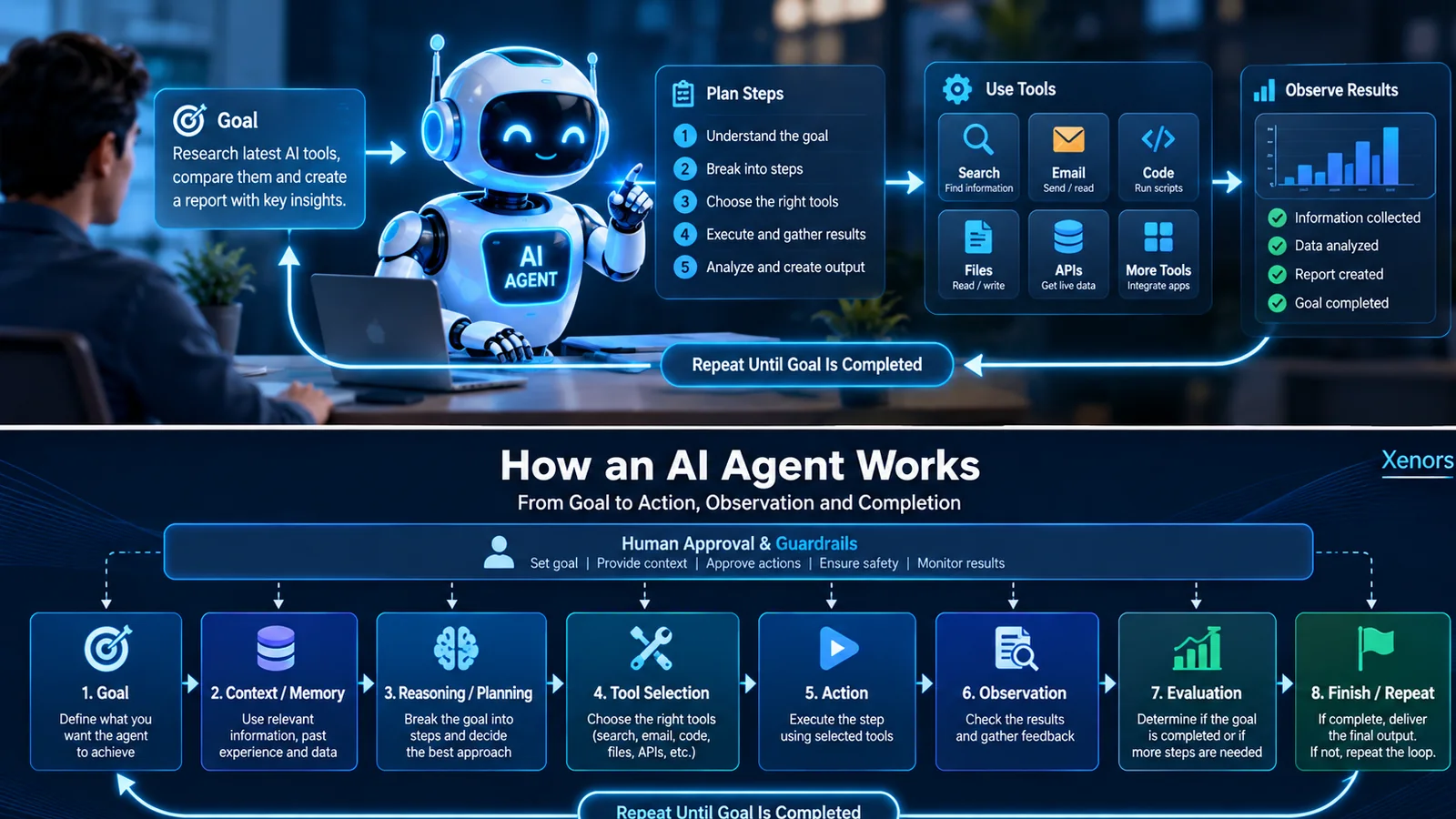

This ai engineer roadmap 2026 is a practical path for developers and students who want to build production AI systems rather than only collect courses. The 2026 market increasingly expects Python, APIs, LLM fundamentals, RAG, agents, evaluation and deployment skills.
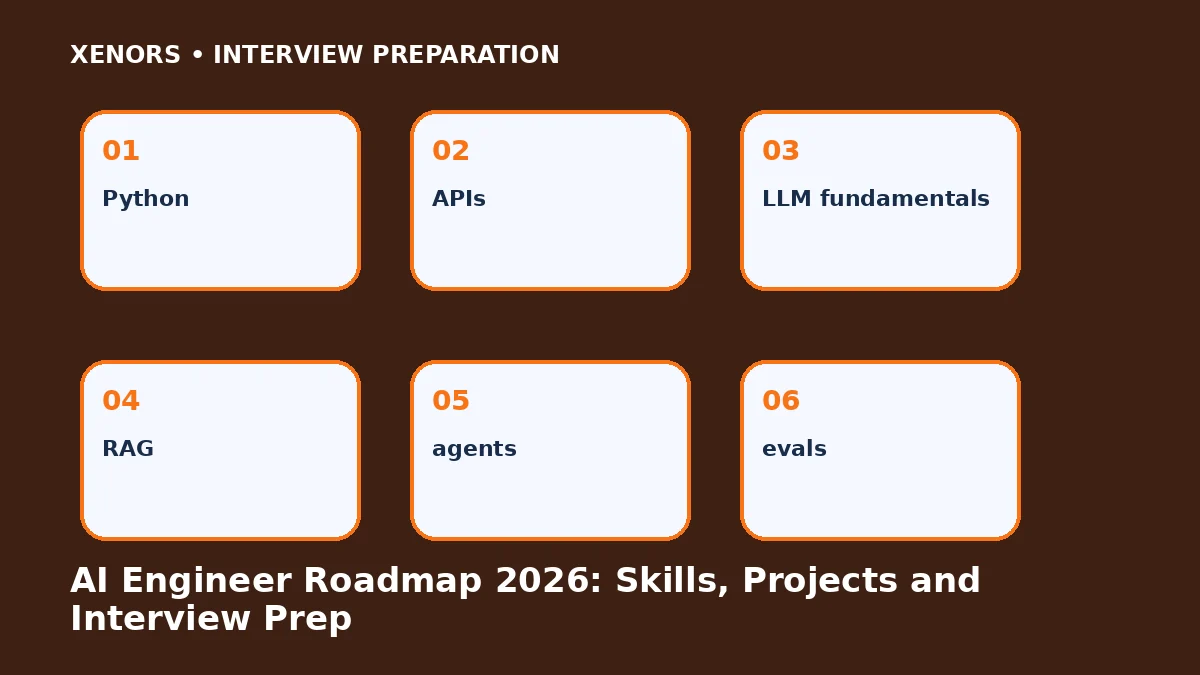
AI engineer roadmap, step by step
Stage 1: Python
Learn the fundamentals, build one small artifact, and define an exit condition before moving on. For Python, focus on practical engineering: write code, test it, measure it, and explain why your implementation is reliable.
Proof of skill: publish a small project or technical note that demonstrates this stage. In interviews, be ready to explain one design decision, one failure, and one metric.
Stage 2: APIs
Learn the fundamentals, build one small artifact, and define an exit condition before moving on. For APIs, focus on practical engineering: write code, test it, measure it, and explain why your implementation is reliable.
Proof of skill: publish a small project or technical note that demonstrates this stage. In interviews, be ready to explain one design decision, one failure, and one metric.
Stage 3: LLM fundamentals
Learn the fundamentals, build one small artifact, and define an exit condition before moving on. For LLM fundamentals, focus on practical engineering: write code, test it, measure it, and explain why your implementation is reliable.
Proof of skill: publish a small project or technical note that demonstrates this stage. In interviews, be ready to explain one design decision, one failure, and one metric.
Stage 4: RAG
Learn the fundamentals, build one small artifact, and define an exit condition before moving on. For RAG, focus on practical engineering: write code, test it, measure it, and explain why your implementation is reliable.
Proof of skill: publish a small project or technical note that demonstrates this stage. In interviews, be ready to explain one design decision, one failure, and one metric.
Stage 5: agents
Learn the fundamentals, build one small artifact, and define an exit condition before moving on. For agents, focus on practical engineering: write code, test it, measure it, and explain why your implementation is reliable.
Proof of skill: publish a small project or technical note that demonstrates this stage. In interviews, be ready to explain one design decision, one failure, and one metric.
Stage 6: evals
Learn the fundamentals, build one small artifact, and define an exit condition before moving on. For evals, focus on practical engineering: write code, test it, measure it, and explain why your implementation is reliable.
Proof of skill: publish a small project or technical note that demonstrates this stage. In interviews, be ready to explain one design decision, one failure, and one metric.
Stage 7: deployment
Learn the fundamentals, build one small artifact, and define an exit condition before moving on. For deployment, focus on practical engineering: write code, test it, measure it, and explain why your implementation is reliable.
Proof of skill: publish a small project or technical note that demonstrates this stage. In interviews, be ready to explain one design decision, one failure, and one metric.
Stage 8: portfolio & interviews
Learn the fundamentals, build one small artifact, and define an exit condition before moving on. For portfolio & interviews, focus on practical engineering: write code, test it, measure it, and explain why your implementation is reliable.
Proof of skill: publish a small project or technical note that demonstrates this stage. In interviews, be ready to explain one design decision, one failure, and one metric.
Three portfolio projects to finish before interviews
Build a production-style RAG service, a tool-using agent, and an evaluation harness. These three artifacts force you to practice retrieval, tool interfaces, state, failure handling, latency, cost and quality measurement.
Interview preparation checklist
Prepare concise explanations for tokens, embeddings, context windows, RAG, function calling, agent loops, evals, caching, retries, rate limits, observability, prompt injection and deployment trade-offs. Then practice one system-design problem end to end.
How to make your answers stand out
Interviewers remember candidates who can connect theory to a real decision. When you answer, say what you would measure, what baseline you would compare against, and what could invalidate your approach. If the question is ambiguous, state your assumption. If you do not know an exact detail, explain how you would verify it rather than bluffing.
Use project stories with numbers when possible: dataset size, latency, error rate, cost, throughput, accuracy, recall, or business impact. The point is not to impress with large numbers; it is to show that you measured something meaningful and learned from failures.
Behavioral and project follow-up questions
Technical interviews often turn into project deep dives. Be ready for: What was the hardest bug? What did you personally own? What did you try that failed? How did you validate the result? What would you do with more time? How did you communicate uncertainty? These questions test engineering maturity and honesty.
A useful STAR-style answer can work for technical stories: situation, task, action and result. Add one more element—reflection—so you can explain what you would change next time.
Final checklist before the interview
- Can you explain each core concept in 60–90 seconds?
- Can you write or discuss code without relying on autocomplete?
- Can you explain one project architecture from input to output?
- Can you defend your metric choice?
- Can you name one failure mode and mitigation?
- Can you discuss cost, latency, scalability and monitoring?
- Can you explain your contribution clearly and honestly?
Frequently asked questions
How many questions should I practice?
Practice enough questions to cover the concept map, not hundreds of isolated facts. Once you can explain fundamentals, trade-offs and scenarios, new questions become easier because you can reason from first principles.
Should freshers study system design?
Yes, but at an appropriate depth. You should be able to describe a small end-to-end system, data flow, evaluation and deployment. Senior candidates are expected to go deeper into scale, reliability and operations.
Are projects more important than certificates?
Certificates can show structured learning, but projects provide stronger evidence that you can build, debug and evaluate something. A well-documented project also creates concrete material for interview discussion.
How should I use this page?
Read one section, close the page, then answer the question aloud in your own words. Compare your answer with the model structure and add an example from your own work. Active recall is more useful than repeatedly rereading the same notes.
Extra revision notes for AI Engineer Roadmap 2026: Skills, Projects and Interview Prep
For the ai engineer roadmap 2026 search intent, focus on the concepts that connect directly to real work: Python, APIs, LLM fundamentals, RAG, agents, evals, deployment, portfolio & interviews. Practice explaining each item with a definition, an example, a measurable success criterion and one limitation. This turns a memorized answer into an engineering answer.
During revision, create a one-page sheet with the main formulas, metrics, architecture patterns and debugging questions. Then solve one scenario without notes. If you get stuck, record the gap and study that exact point instead of rereading the full topic.
Extra revision notes for AI Engineer Roadmap 2026: Skills, Projects and Interview Prep
For the ai engineer roadmap 2026 search intent, focus on the concepts that connect directly to real work: Python, APIs, LLM fundamentals, RAG, agents, evals, deployment, portfolio & interviews. Practice explaining each item with a definition, an example, a measurable success criterion and one limitation. This turns a memorized answer into an engineering answer.
During revision, create a one-page sheet with the main formulas, metrics, architecture patterns and debugging questions. Then solve one scenario without notes. If you get stuck, record the gap and study that exact point instead of rereading the full topic.
Extra revision notes for AI Engineer Roadmap 2026: Skills, Projects and Interview Prep
For the ai engineer roadmap 2026 search intent, focus on the concepts that connect directly to real work: Python, APIs, LLM fundamentals, RAG, agents, evals, deployment, portfolio & interviews. Practice explaining each item with a definition, an example, a measurable success criterion and one limitation. This turns a memorized answer into an engineering answer.
During revision, create a one-page sheet with the main formulas, metrics, architecture patterns and debugging questions. Then solve one scenario without notes. If you get stuck, record the gap and study that exact point instead of rereading the full topic.
Extra revision notes for AI Engineer Roadmap 2026: Skills, Projects and Interview Prep
For the ai engineer roadmap 2026 search intent, focus on the concepts that connect directly to real work: Python, APIs, LLM fundamentals, RAG, agents, evals, deployment, portfolio & interviews. Practice explaining each item with a definition, an example, a measurable success criterion and one limitation. This turns a memorized answer into an engineering answer.
During revision, create a one-page sheet with the main formulas, metrics, architecture patterns and debugging questions. Then solve one scenario without notes. If you get stuck, record the gap and study that exact point instead of rereading the full topic.
Extra revision notes for AI Engineer Roadmap 2026: Skills, Projects and Interview Prep
For the ai engineer roadmap 2026 search intent, focus on the concepts that connect directly to real work: Python, APIs, LLM fundamentals, RAG, agents, evals, deployment, portfolio & interviews. Practice explaining each item with a definition, an example, a measurable success criterion and one limitation. This turns a memorized answer into an engineering answer.
During revision, create a one-page sheet with the main formulas, metrics, architecture patterns and debugging questions. Then solve one scenario without notes. If you get stuck, record the gap and study that exact point instead of rereading the full topic.
Extra revision notes for AI Engineer Roadmap 2026: Skills, Projects and Interview Prep
For the ai engineer roadmap 2026 search intent, focus on the concepts that connect directly to real work: Python, APIs, LLM fundamentals, RAG, agents, evals, deployment, portfolio & interviews. Practice explaining each item with a definition, an example, a measurable success criterion and one limitation. This turns a memorized answer into an engineering answer.
During revision, create a one-page sheet with the main formulas, metrics, architecture patterns and debugging questions. Then solve one scenario without notes. If you get stuck, record the gap and study that exact point instead of rereading the full topic.
Extra revision notes for AI Engineer Roadmap 2026: Skills, Projects and Interview Prep
For the ai engineer roadmap 2026 search intent, focus on the concepts that connect directly to real work: Python, APIs, LLM fundamentals, RAG, agents, evals, deployment, portfolio & interviews. Practice explaining each item with a definition, an example, a measurable success criterion and one limitation. This turns a memorized answer into an engineering answer.
During revision, create a one-page sheet with the main formulas, metrics, architecture patterns and debugging questions. Then solve one scenario without notes. If you get stuck, record the gap and study that exact point instead of rereading the full topic.
Extra revision notes for AI Engineer Roadmap 2026: Skills, Projects and Interview Prep
For the ai engineer roadmap 2026 search intent, focus on the concepts that connect directly to real work: Python, APIs, LLM fundamentals, RAG, agents, evals, deployment, portfolio & interviews. Practice explaining each item with a definition, an example, a measurable success criterion and one limitation. This turns a memorized answer into an engineering answer.
During revision, create a one-page sheet with the main formulas, metrics, architecture patterns and debugging questions. Then solve one scenario without notes. If you get stuck, record the gap and study that exact point instead of rereading the full topic.
Extra revision notes for AI Engineer Roadmap 2026: Skills, Projects and Interview Prep
For the ai engineer roadmap 2026 search intent, focus on the concepts that connect directly to real work: Python, APIs, LLM fundamentals, RAG, agents, evals, deployment, portfolio & interviews. Practice explaining each item with a definition, an example, a measurable success criterion and one limitation. This turns a memorized answer into an engineering answer.
During revision, create a one-page sheet with the main formulas, metrics, architecture patterns and debugging questions. Then solve one scenario without notes. If you get stuck, record the gap and study that exact point instead of rereading the full topic.
Extra revision notes for AI Engineer Roadmap 2026: Skills, Projects and Interview Prep
For the ai engineer roadmap 2026 search intent, focus on the concepts that connect directly to real work: Python, APIs, LLM fundamentals, RAG, agents, evals, deployment, portfolio & interviews. Practice explaining each item with a definition, an example, a measurable success criterion and one limitation. This turns a memorized answer into an engineering answer.
During revision, create a one-page sheet with the main formulas, metrics, architecture patterns and debugging questions. Then solve one scenario without notes. If you get stuck, record the gap and study that exact point instead of rereading the full topic.