
If you are searching for machine learning projects for beginners, the goal is not to collect random project names. The goal is to build projects that prove you can frame a problem, implement a system, evaluate it honestly and explain trade-offs in an interview.
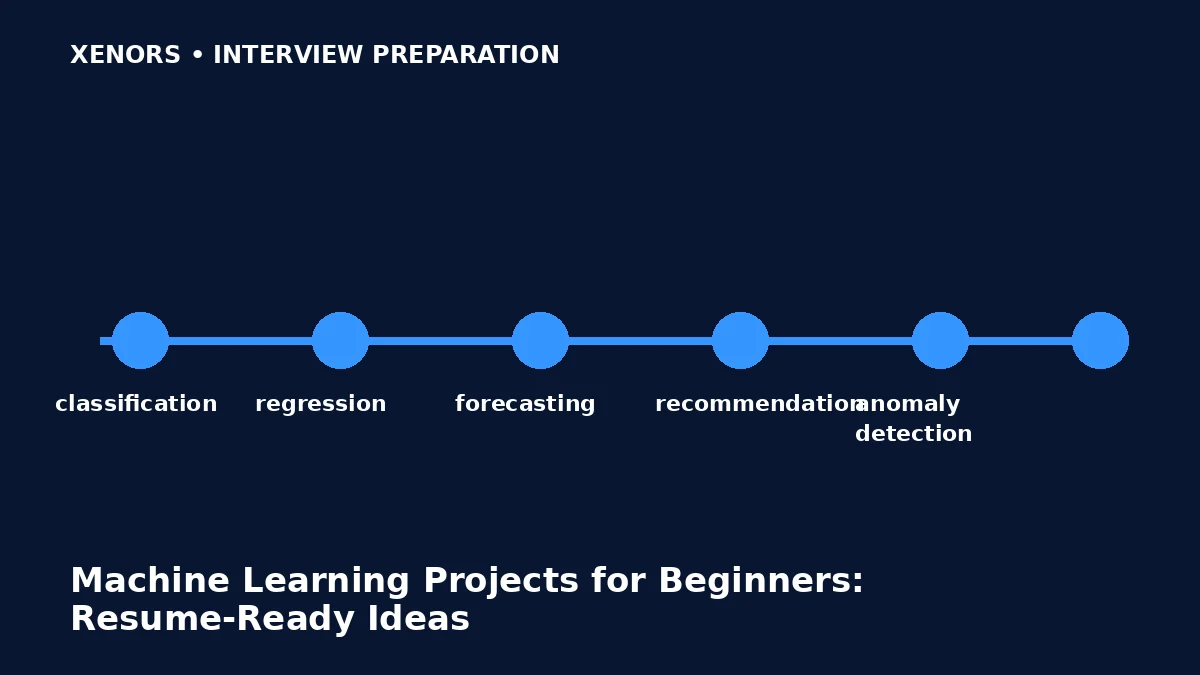
Best projects to build
1. Classification Project
What to build: Build a small but complete system that solves a clear user problem. Avoid a notebook-only demo; include input validation, reproducible setup, a simple interface or API, and a README that explains decisions.
Suggested stack: scikit-learn, pandas, feature pipeline.
Metrics to report: F1, ROC-AUC, calibration. Add a baseline so the interviewer can see whether your approach actually improved anything.
Interview talking points: Explain the hardest failure you found, one trade-off you made, how you tested the system, and what you would change for production scale. A project becomes interview-worthy when you can discuss evidence, not just features.
2. Regression Project
What to build: Build a small but complete system that solves a clear user problem. Avoid a notebook-only demo; include input validation, reproducible setup, a simple interface or API, and a README that explains decisions.
Suggested stack: pandas, scikit-learn, feature engineering.
Metrics to report: MAE, RMSE, residual analysis. Add a baseline so the interviewer can see whether your approach actually improved anything.
Interview talking points: Explain the hardest failure you found, one trade-off you made, how you tested the system, and what you would change for production scale. A project becomes interview-worthy when you can discuss evidence, not just features.
3. Time-Series Forecasting
What to build: Build a small but complete system that solves a clear user problem. Avoid a notebook-only demo; include input validation, reproducible setup, a simple interface or API, and a README that explains decisions.
Suggested stack: pandas, statsmodels/ML, backtesting.
Metrics to report: MAE/MAPE, backtest stability. Add a baseline so the interviewer can see whether your approach actually improved anything.
Interview talking points: Explain the hardest failure you found, one trade-off you made, how you tested the system, and what you would change for production scale. A project becomes interview-worthy when you can discuss evidence, not just features.
4. Recommendation System
What to build: Build a small but complete system that solves a clear user problem. Avoid a notebook-only demo; include input validation, reproducible setup, a simple interface or API, and a README that explains decisions.
Suggested stack: embeddings/collaborative filtering, ranking.
Metrics to report: precision@k, recall@k, coverage. Add a baseline so the interviewer can see whether your approach actually improved anything.
Interview talking points: Explain the hardest failure you found, one trade-off you made, how you tested the system, and what you would change for production scale. A project becomes interview-worthy when you can discuss evidence, not just features.
5. Anomaly Detection System
What to build: Build a small but complete system that solves a clear user problem. Avoid a notebook-only demo; include input validation, reproducible setup, a simple interface or API, and a README that explains decisions.
Suggested stack: Isolation Forest/autoencoder, monitoring.
Metrics to report: precision, recall, alert burden. Add a baseline so the interviewer can see whether your approach actually improved anything.
Interview talking points: Explain the hardest failure you found, one trade-off you made, how you tested the system, and what you would change for production scale. A project becomes interview-worthy when you can discuss evidence, not just features.
6. NLP Classification App
What to build: Build a small but complete system that solves a clear user problem. Avoid a notebook-only demo; include input validation, reproducible setup, a simple interface or API, and a README that explains decisions.
Suggested stack: tokenization, embeddings/transformer, API.
Metrics to report: F1, confusion matrix, latency. Add a baseline so the interviewer can see whether your approach actually improved anything.
Interview talking points: Explain the hardest failure you found, one trade-off you made, how you tested the system, and what you would change for production scale. A project becomes interview-worthy when you can discuss evidence, not just features.
7. Computer Vision Detector
What to build: Build a small but complete system that solves a clear user problem. Avoid a notebook-only demo; include input validation, reproducible setup, a simple interface or API, and a README that explains decisions.
Suggested stack: YOLO/CNN, augmentation, deployment.
Metrics to report: mAP, recall, FPS. Add a baseline so the interviewer can see whether your approach actually improved anything.
Interview talking points: Explain the hardest failure you found, one trade-off you made, how you tested the system, and what you would change for production scale. A project becomes interview-worthy when you can discuss evidence, not just features.
8. Deployed ML API
What to build: Build a small but complete system that solves a clear user problem. Avoid a notebook-only demo; include input validation, reproducible setup, a simple interface or API, and a README that explains decisions.
Suggested stack: FastAPI, Docker, model artifact, monitoring.
Metrics to report: latency, uptime, drift. Add a baseline so the interviewer can see whether your approach actually improved anything.
Interview talking points: Explain the hardest failure you found, one trade-off you made, how you tested the system, and what you would change for production scale. A project becomes interview-worthy when you can discuss evidence, not just features.
How to make a project recruiter-ready
A strong portfolio project has five layers: a clear problem statement, a reproducible data or input pipeline, a baseline, measurable evaluation, and a deployed or demonstrable result. Recruiters increasingly distinguish between tutorial clones and projects where the candidate made engineering decisions. Add an architecture diagram, tests, failure examples and a short demo video or screenshots.
What interviewers will ask about your project
Expect questions such as: Why did you choose this dataset? What was the baseline? Which metric mattered and why? Where did the system fail? How did you prevent leakage? What would change at 100× traffic? How would you reduce latency or cost? What did you personally implement? Prepare concise answers supported by numbers.
How to document each project
Write the README as if another engineer will review it. Include the problem, setup steps, architecture, data assumptions, metrics, error analysis, screenshots, known limitations and next steps. Keep secrets out of the repository and provide a sample environment file when APIs are required.
Common portfolio mistakes
- Copying a tutorial without changing the problem or evaluation.
- Reporting only accuracy with no baseline or class-level errors.
- Using a huge stack when a simpler system would work.
- No deployment, demo or reproducible instructions.
- No discussion of failure cases, data quality or cost.
7-day interview rehearsal plan
Day 1: write a 90-second project summary. Day 2: rehearse architecture. Day 3: review metrics and error cases. Day 4: explain one trade-off. Day 5: prepare scaling and deployment answers. Day 6: do a mock interview. Day 7: simplify the story and verify every number in your README.
How to make your answers stand out
Interviewers remember candidates who can connect theory to a real decision. When you answer, say what you would measure, what baseline you would compare against, and what could invalidate your approach. If the question is ambiguous, state your assumption. If you do not know an exact detail, explain how you would verify it rather than bluffing.
Use project stories with numbers when possible: dataset size, latency, error rate, cost, throughput, accuracy, recall, or business impact. The point is not to impress with large numbers; it is to show that you measured something meaningful and learned from failures.
Behavioral and project follow-up questions
Technical interviews often turn into project deep dives. Be ready for: What was the hardest bug? What did you personally own? What did you try that failed? How did you validate the result? What would you do with more time? How did you communicate uncertainty? These questions test engineering maturity and honesty.
A useful STAR-style answer can work for technical stories: situation, task, action and result. Add one more element—reflection—so you can explain what you would change next time.
Final checklist before the interview
- Can you explain each core concept in 60–90 seconds?
- Can you write or discuss code without relying on autocomplete?
- Can you explain one project architecture from input to output?
- Can you defend your metric choice?
- Can you name one failure mode and mitigation?
- Can you discuss cost, latency, scalability and monitoring?
- Can you explain your contribution clearly and honestly?
Frequently asked questions
How many questions should I practice?
Practice enough questions to cover the concept map, not hundreds of isolated facts. Once you can explain fundamentals, trade-offs and scenarios, new questions become easier because you can reason from first principles.
Should freshers study system design?
Yes, but at an appropriate depth. You should be able to describe a small end-to-end system, data flow, evaluation and deployment. Senior candidates are expected to go deeper into scale, reliability and operations.
Are projects more important than certificates?
Certificates can show structured learning, but projects provide stronger evidence that you can build, debug and evaluate something. A well-documented project also creates concrete material for interview discussion.
How should I use this page?
Read one section, close the page, then answer the question aloud in your own words. Compare your answer with the model structure and add an example from your own work. Active recall is more useful than repeatedly rereading the same notes.
Extra revision notes for Machine Learning Projects for Beginners: Resume-Ready Ideas
For the machine learning projects for beginners search intent, focus on the concepts that connect directly to real work: classification, regression, forecasting, recommendation, anomaly detection, NLP classifier, computer vision, deployment. Practice explaining each item with a definition, an example, a measurable success criterion and one limitation. This turns a memorized answer into an engineering answer.
During revision, create a one-page sheet with the main formulas, metrics, architecture patterns and debugging questions. Then solve one scenario without notes. If you get stuck, record the gap and study that exact point instead of rereading the full topic.
Extra revision notes for Machine Learning Projects for Beginners: Resume-Ready Ideas
For the machine learning projects for beginners search intent, focus on the concepts that connect directly to real work: classification, regression, forecasting, recommendation, anomaly detection, NLP classifier, computer vision, deployment. Practice explaining each item with a definition, an example, a measurable success criterion and one limitation. This turns a memorized answer into an engineering answer.
During revision, create a one-page sheet with the main formulas, metrics, architecture patterns and debugging questions. Then solve one scenario without notes. If you get stuck, record the gap and study that exact point instead of rereading the full topic.
Extra revision notes for Machine Learning Projects for Beginners: Resume-Ready Ideas
For the machine learning projects for beginners search intent, focus on the concepts that connect directly to real work: classification, regression, forecasting, recommendation, anomaly detection, NLP classifier, computer vision, deployment. Practice explaining each item with a definition, an example, a measurable success criterion and one limitation. This turns a memorized answer into an engineering answer.
During revision, create a one-page sheet with the main formulas, metrics, architecture patterns and debugging questions. Then solve one scenario without notes. If you get stuck, record the gap and study that exact point instead of rereading the full topic.
Extra revision notes for Machine Learning Projects for Beginners: Resume-Ready Ideas
For the machine learning projects for beginners search intent, focus on the concepts that connect directly to real work: classification, regression, forecasting, recommendation, anomaly detection, NLP classifier, computer vision, deployment. Practice explaining each item with a definition, an example, a measurable success criterion and one limitation. This turns a memorized answer into an engineering answer.
During revision, create a one-page sheet with the main formulas, metrics, architecture patterns and debugging questions. Then solve one scenario without notes. If you get stuck, record the gap and study that exact point instead of rereading the full topic.
Extra revision notes for Machine Learning Projects for Beginners: Resume-Ready Ideas
For the machine learning projects for beginners search intent, focus on the concepts that connect directly to real work: classification, regression, forecasting, recommendation, anomaly detection, NLP classifier, computer vision, deployment. Practice explaining each item with a definition, an example, a measurable success criterion and one limitation. This turns a memorized answer into an engineering answer.
During revision, create a one-page sheet with the main formulas, metrics, architecture patterns and debugging questions. Then solve one scenario without notes. If you get stuck, record the gap and study that exact point instead of rereading the full topic.