
If you searched "can trading make you a millionaire in India", you are probably trying to understand whether the stock market can produce reliable income and what it would take. Markets can create wealth, but they do not provide a fixed salary. Results depend on capital, time horizon, market conditions, diversification, costs, tax and risk.
This guide gives a realistic beginner-friendly answer and avoids guaranteed-return claims. Aggressive daily targets can push people toward overtrading, leverage and low-quality tips, so the focus here is on maths, risk and a repeatable process.
How wealth is actually built in markets
Markets can help people build substantial wealth, but the repeatable path is usually boring: save consistently, diversify, control costs, avoid catastrophic losses and let compounding work for many years. Trying to become rich quickly often encourages leverage and oversized positions.
Your starting capital, savings rate, time horizon and realized return all matter. No article can promise a timetable to millionaire or billionaire status.
Investor education note: Stock-market returns are not guaranteed. NSE investor education emphasizes starting early, investing regularly and thinking long term, while SEBI warns against guaranteed-return promises and unverified tips. This page is educational, not personalized investment advice.
Investing and trading are different
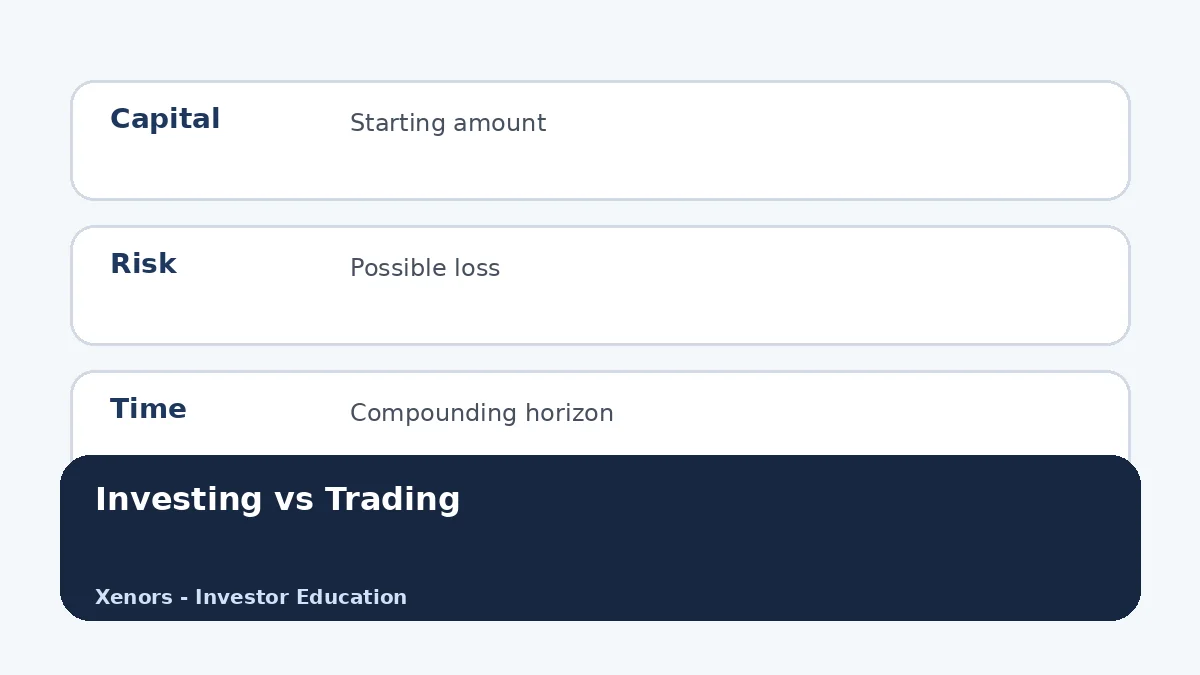
Investing usually means owning assets for years based on business quality, diversification and long-term goals. Trading means taking shorter-term positions based on price movement, catalysts or a tested strategy. Frequent trading adds timing, execution, slippage and emotional risk.
A realistic framework for beginners
1. Build financial stability first
Keep emergency savings and near-term essential expenses separate from money exposed to market risk. Avoid using rent, medical or education money for speculative trades.
2. Define the goal and time horizon
A retirement goal 20 years away is different from trying to generate income next month. Short horizons leave less time to recover from declines.
3. Diversify
Concentrating in one company or theme increases the chance that one bad event damages the portfolio. Diversification cannot eliminate loss, but it reduces dependence on a single outcome.
4. Understand all costs
Brokerage, exchange charges, spreads, slippage, taxes and financing costs matter. High turnover can turn a small theoretical edge into a loss.
5. Be careful with leverage
Borrowed money and derivatives magnify both gains and losses. Beginners should understand worst-case outcomes before using leveraged products.
How to research a stock instead of chasing a tip
Review revenue, margins, free cash flow, debt, return on capital, competitive position, management quality, valuation and the risks that could invalidate the thesis. Use official filings and exchange announcements where possible.
A stock that fell 30% is not automatically cheap, and a stock at a new high is not automatically expensive. Price has to be compared with business quality and future economics.
Daily income versus long-term compounding
A daily-income mindset asks how much can be made today. A compounding mindset asks how to avoid permanent loss, keep adding capital and stay invested for years. Investor.gov explains that compound growth comes from earning returns on both invested money and prior gains.
Red flags to avoid
- Guaranteed daily or monthly returns.
- Anonymous Telegram or WhatsApp tips.
- Pressure to deposit immediately.
- Claims of zero risk or 100% accuracy.
- Unregistered advisers or brokers.
- Borrowing money to trade.
- Only showing winning screenshots.
What a sensible plan can look like
Learn market basics, use a regulated intermediary, start with an amount that does not threaten essential expenses and keep records of decisions. If actively trading, test a strategy before increasing size and track win rate, average win, average loss, maximum drawdown and all costs.
If the goal is long-term wealth, compare a diversified low-cost fund or ETF with the difficulty of selecting individual winners. Simpler approaches can be easier to follow consistently.
Practical example: process matters more than one result
Investor A makes a profit today with an oversized unplanned position. Investor B follows a diversified plan and keeps risk within a predefined limit. The first screenshot may look better, but the second process is more repeatable because it does not depend on one lucky outcome.
A good process can still produce a losing day, while a poor process can produce an occasional winner. Judge a strategy across many decisions, not one result.
Questions to ask before risking money
- Why am I entering this position?
- What would prove the thesis wrong?
- How much can I lose without damaging essential goals?
- Am I using verified information or an anonymous tip?
- What are the total costs?
- Would I still take this position if it were not trending online?
Frequently asked questions
Can stock-market income be guaranteed?
No. Prices fluctuate and returns are uncertain.
Can beginners make money from stocks?
Yes, but beginners can also lose money. Education, diversification and risk control matter.
Is trading every day necessary?
No. Many long-term investors trade infrequently.
How much should a beginner start with?
There is no universal amount. Start with money you can afford to keep invested and see fluctuate.
What should I learn first?
Learn order types, basic financial statements, diversification, costs, tax and risk management.
Bottom line
The stock market can build wealth, but it is not a machine that pays a fixed daily salary. A stronger objective is to protect capital, use a clear process, keep expectations realistic and let time and discipline do more of the work.
Further perspective for beginners
Market outcomes are distributions, not promises. Instead of asking what profit is possible on the best day, ask what loss is possible on a bad day and whether the account can survive a series of losses. This shift from outcome chasing to risk-first thinking is one of the most useful habits a beginner can develop.
Keep expectations grounded, compare decisions with your written plan and review results over a meaningful sample size. If a strategy only works when ignoring fees, taxes or losing trades, it is not a robust strategy.
Further perspective for beginners
Market outcomes are distributions, not promises. Instead of asking what profit is possible on the best day, ask what loss is possible on a bad day and whether the account can survive a series of losses. This shift from outcome chasing to risk-first thinking is one of the most useful habits a beginner can develop.
Keep expectations grounded, compare decisions with your written plan and review results over a meaningful sample size. If a strategy only works when ignoring fees, taxes or losing trades, it is not a robust strategy.
Further perspective for beginners
Market outcomes are distributions, not promises. Instead of asking what profit is possible on the best day, ask what loss is possible on a bad day and whether the account can survive a series of losses. This shift from outcome chasing to risk-first thinking is one of the most useful habits a beginner can develop.
Keep expectations grounded, compare decisions with your written plan and review results over a meaningful sample size. If a strategy only works when ignoring fees, taxes or losing trades, it is not a robust strategy.
Further perspective for beginners
Market outcomes are distributions, not promises. Instead of asking what profit is possible on the best day, ask what loss is possible on a bad day and whether the account can survive a series of losses. This shift from outcome chasing to risk-first thinking is one of the most useful habits a beginner can develop.
Keep expectations grounded, compare decisions with your written plan and review results over a meaningful sample size. If a strategy only works when ignoring fees, taxes or losing trades, it is not a robust strategy.
Further perspective for beginners
Market outcomes are distributions, not promises. Instead of asking what profit is possible on the best day, ask what loss is possible on a bad day and whether the account can survive a series of losses. This shift from outcome chasing to risk-first thinking is one of the most useful habits a beginner can develop.
Keep expectations grounded, compare decisions with your written plan and review results over a meaningful sample size. If a strategy only works when ignoring fees, taxes or losing trades, it is not a robust strategy.
Further perspective for beginners
Market outcomes are distributions, not promises. Instead of asking what profit is possible on the best day, ask what loss is possible on a bad day and whether the account can survive a series of losses. This shift from outcome chasing to risk-first thinking is one of the most useful habits a beginner can develop.
Keep expectations grounded, compare decisions with your written plan and review results over a meaningful sample size. If a strategy only works when ignoring fees, taxes or losing trades, it is not a robust strategy.
Further perspective for beginners
Market outcomes are distributions, not promises. Instead of asking what profit is possible on the best day, ask what loss is possible on a bad day and whether the account can survive a series of losses. This shift from outcome chasing to risk-first thinking is one of the most useful habits a beginner can develop.
Keep expectations grounded, compare decisions with your written plan and review results over a meaningful sample size. If a strategy only works when ignoring fees, taxes or losing trades, it is not a robust strategy.